

Regular Free Updates 300-510 Dumps Real Exam Questions Test Engine Nov 05, 2025
Practice Test Questions Verified Answers As Experienced in the Actual Test!
Obtaining the Cisco 300-510 certification demonstrates a high level of expertise in advanced routing solutions and is highly valued by employers in the service provider industry. It also provides a solid foundation for career advancement in areas such as network engineering, network architecture, and network operations.
Cisco 300-510 exam covers a wide range of topics related to advanced routing solutions in a service provider network. These topics include BGP, OSPF, IS-IS, MPLS, Segment Routing, EVPN, VRF, and more. 300-510 exam also tests the candidate's ability to troubleshoot complex routing issues in a service provider network environment. 300-510 exam is designed to ensure that the candidate has a thorough understanding of the technology and is able to apply it in real-world scenarios.
Cisco 300-510 certification exam is an essential credential for networking professionals who want to demonstrate their expertise in implementing advanced routing solutions in a service provider environment. With this certification, professionals can advance their career and gain recognition as experts in this field.
NEW QUESTION # 139 

Answer:
Explanation:
See the solution below in Explanation.
Explanation:
Solution :-
R1
Router bgp 100
Neigh 10.3.3.3 remote-as 100
Neigh 10.3.3.3 update-source loopback0
Address-family ipv4
Neigh 10.3.3.3 next-hop-self
Aggregate-address 172.16.100.0 255.255.252.0 summary-only
Copy run start
R3
Router bgp 100
Neigh 10.1.1.1 remote-as 100
Neigh 10.1.1.1 update-source loopback 0
Copy run start
Verification:-
Text Description automatically generated

NEW QUESTION # 140
Refer to the exhibit. What is the relationship between Router 1 and Router 2?
- A. Router 1 and Router 2 are participating in SR-TE tunnels and are both head-end routers.
- B. Router 1 centrally learns the topology of the network to aid in SR-TE path selection, and Router 2 is a node that feeds Router 1 topology information.
- C. Router 2 is the head-end router in an SR-TE tunnel, and it is learning topology of the network from the PCE enabled on Router 1.
- D. Router 1 and Router 2 centrally learn the topology of the network to aid in SR-TE path selection for peers.
Answer: C
NEW QUESTION # 141
Refer to the exhibit.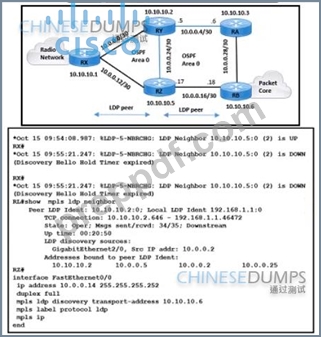
Refer to the exhibit MPLS traffic from the packet core that is connected to router RX (10 10 101) to the radio network that is connected to router RB (10 10 10 6) uses the longer route RB R2 RY RX RX and R2 are configured with a default value of LDP hello and hold intervals The team verified that OSPF neighborship in Area 0 is established between RX and R2 Which action must be taken to choose the shortest path and resolve the issue?
- A.

- B.

- C.

- D.

Answer: B
NEW QUESTION # 142
Refer to the exhibit. Company X is multihomed to a service provider. With the default settings, the link between PE2 and CE1 is the primary link, but company X has asked for the link between PE4 and CE2 to operate as the primary instead. A network engineer used a route map with local- preference to manipulate the routes from PE2 to CE1 to be less desirable and applied the route map on PE2 outbound to CE1. However, the path from PE2 to CE1 is still preferred.
Which action must the engineer take so that the desired path is chosen?
- A. Configure the weight attribute on PE2 in the outbound direction to CE2 with a value less than
65535. - B. Configure the AS path prepend attribute to increase the number of hops between CE2 and PE4.
- C. Apply MED in the outbound direction on PE2 to CE1 with a cost lower than the path from PE4 to CE2.
- D. Apply local-preference on PE2 outbound to CE2 with a value less than 100.
Answer: B
NEW QUESTION # 143
Refer to the exhibit.
Router 1 has established an SR-TE tunnel with router 2. Which statement describes this configuration?
- A. Router 1 and router 2 have a bidirectional tunnel set up with dynamic path selection.
- B. Router 2 is the head-end tunnel and has explicitly set a path to router 1.
- C. Router 1 is the head-end tunnel and has dynamically chosen a path to router 2.
- D. Router 1 has a list of labels used to explicitly lay out a path to router 2.
Answer: C
NEW QUESTION # 144
Refer to the exhibit. An engineer is troubleshooting IS-IS configuration between two areas. IS-IS Area-A network 30.1.1.0/24 is leaked into IS-IS Area-B. R2 is failing to filter the route updates from network 10.1.1.0/24. Which configuration must the engineer apply to resolve the issue?
- A. R2(config)# ip prefix-list List2 seq 5 deny 10.1.1.0/24
R2(config)# interface fastethernet 0/0
R2(config-if)# ip router isis 100
R2(config-if)# router isis 100
R2(config-router)# distribute-list gateway List2 in - B. R2(config)# access-list 101 deny ip any 10.1.1.0 0.0.0.127
R2(config)# access-list 101 permit ip any 30.1.1.0 0.0.0.63
R2(config)# access-list 101 deny ip any 0.0.0.0 0.0.0.0
R2(config)# interface fastethernet 0/0
R2(config-if)# ip router isis 121
R2(config-if)# router isis 121
R2(config-router)# distribute-list 101 in - C. R1(config)# ip prefix-list List2 seq 5 deny 10.1.1.0/24
R1(config)# interface fastethernet 0/0
R1(config-if)# ip router isis 100
R1(config-if)# router isis 100
R1(config-router)# distribute-list gateway List2 in
R (config-if)# router isis 150
R1(config-router)# distribute-list route-map Map1 in - D. R2(config)# ip prefix-list List1 seq 3 deny 10.1.1.0/24
R2(config)# ip prefix-list List1 seq 5 permit 30.1.1.0/24 ge 25 1e
R2(config)# ip prefix-list List1 seq 10 permit 0.0.0.0/le 32
R2(config)# interface fastethernet 0/0
R2(config-if)# ip router isis 122
R2(config-if)# router isis 122
R2(config-router)# distribute-list prefix List1 in
Answer: C
Explanation:
https://www.cisco.com/c/en/us/td/docs/ios-xml/ios/iproute_isis/configuration/15-mt/irs-15-mt- book/isis-inbound-filtering.html
NEW QUESTION # 145
Referring to the topology diagram show in the exhibit, which three statements are correct regarding the BGP routing updates? (Choose three.)
- A. The IBGP routing updates received by R3 from R2 will be propagated to the R6 router
- B. The IBGP routing updates received by R1 from R4 will be propagated to the R5, R7, and R2 routers
- C. The EBGP routing updates received by R3 from R6 will be propagated to the R2 and R4 routers
- D. The EBGP routing updates received by R1 from R5 will be propagated to the R2, R4, and R7 routers
- E. The EBGP routing updates received by R1 from R5 will be propagated to the R2 and R4 routers
- F. The IBGP routing updates received by R2 from R1 will be propagated to the R3 router
Answer: A,C,D
NEW QUESTION # 146
Which two statements about route reflectors are true? (Choose two.)
- A. Routes received from nonclient peers are reflected to route reflector clients as well as nonclient peers.
- B. Routes received from a route reflector client is reflected to other clients and nonclient peers.
- C. If a router received an iBGP route with the originator-ID attribute set to its own router ID, the route is discarded.
- D. If a route reflector receives a route with a cluster-list attribute containing a different cluster ID, the route is discarded.
- E. Routes received from nonclient peers are reflected to route reflector cluster as well as OSPF peers.
Answer: B,C
NEW QUESTION # 147
Refer to the exhibit. Router 1 is connected to router 2 on interface TenGigE0/1.
Which interface provides the alternate path to 172.16.200.9/32 when the link between router 1 and router 2 goes down?
- A. TenGigE0/1 interface provides the alternate path
- B. A backup path must be statically installed
- C. A primary path must be manually installed
- D. TenGigE0/2 interface provides the alternate path
Answer: D
NEW QUESTION # 148
Level 3 switch SW1 is part of an EIGRP enabled network located at the edge of an area. Cisco Express Forwarding and SSO are enabled on the router. A network engineer must minimize the downtime of data-transmit services in the network. HSRP group 2 has already been configured with standby preempt delay minimum 2 and standby timers 140.
Which additional action must the engineer take on SW1 to suppress routing flaps for 2 minutes?
- A. Configure timers nsf signal 2 under the global EIGRP IPv4 address family.
- B. Configure timers standby 2 coverage 120 under the HSRP group 2 configuration.
- C. Configure timers standby 2 wait 2 under the HSRP group 2 configuration.
- D. Configure timers nsf route-hold 120 under the global EIGRP configuration.
Answer: D
NEW QUESTION # 149
Refer to the exhibit.
Routers R1 and R2 reside in AS 65530, which is multihomed to the Internet. A network engineer expects devices in the AS to use R2 to access the Internet, but they are using R1 as the exit point from the AS. Which action corrects the problem?
- A. Add a sequence number to the route map to remove the implicit deny.
- B. Remove the neighbor statements from the address family configuration and activate the neighbor globally on R1.
- C. Configure the route map with a local preference of 200 or higher.
- D. Change the route map direction in the neighbor statement to out
Answer: D
NEW QUESTION # 150
Refer to the exhibit.
A network operator is working to filter routes from being advertised that are covered under an aggregate announcement. The receiving router of the aggregate announcement block is still getting some of the more specific routes plus the aggregate. Which configuration change ensures that only the aggregate is announced now and in the future if other networks are to be added?
- A. Set each specific route in the AGGRO policy to drop instead of suppress-route
- B. Filter the routes on the receiving router
- C. Configure the summary-only keyword on the aggregate command
- D. Set each specific route in the AGGRO policy to remove instead of suppress-route
Answer: C
NEW QUESTION # 151
Which statement about enabling segment routing for IGPs is true?
- A. Segment routing can be enabled only under the routing process
- B. Segment routing can be enabled only globally
- C. Segment routing must first be enabled under then routing process and then globally
- D. Segment routing must first be enabled globally and then under the routing process
Answer: D
Explanation:
https://www.cisco.com/c/en/us/td/docs/ios-xml/ios/seg_routing/configuration/xe-16-6/segrt-xe-16-
6-book/sr-ospfv2-node-sid.html
NEW QUESTION # 152 
Refer to the exhibit. Router 1 is a core ABR in a Cisco Unified MPLS environment. All of the router 1 BGP peers are established, but traffic between customers is failing. Which BGP configuration must be added to the configuration?
- A. It must be configured with PIC edge
- B. It must be configured with send labels
- C. It must be configured for graceful restart
- D. It must be configured with a route reflector
Answer: B
NEW QUESTION # 153
Compare different features between OSPFv2 and OSPFv3. Drag and drop the descriptions of OSPF from the left onto the correct OSPF versions on the right.
Answer:
Explanation:
NEW QUESTION # 154
Refer to the exhibit.
An engineer is addressing an IS-IS design issue which is running within the topology. All links are running on FastEthernet, except the link between R5 and R4, which is Gigabit Ethernet. Which statement about the design is true?
- A. R4 prefer to reach R5 using R1 as the next hop
- B. R5 prefers to use R4 as the next hop for all routes
- C. R1 prefer to use R5 as the next hop to reach R4
- D. All links have equal cost if the default metric is used
Answer: D
NEW QUESTION # 155
Refer to the exhibit. A network operator is working to deploy a Unified BGP design and allow it to be available only in selected markets and services in the future. The label allocation is not functioning as desired. Which action will fix the issue?
- A. Remove the route policy and only configure "allocate-label".
- B. Remove the allocate-labels command.
- C. Reconfigure the route-policy ALL_LABELS to match all after the drop.
- D. Reconfigure the route-policy ALL_LABELS to pass.
Answer: D
NEW QUESTION # 156
Refer to the exhibit.
Refer to the exhibit. An engineer is troubleshooting a network routing issue on this IS-IS network situated at the customer's regional hub. Router 2 that runs Cisco IOS XR Software cannot see the network 10.1.1.0/24 on router 1. The Layer 2 encapsulations are correct. The ARP connectivity for the Ethernet interface that runs IS-IS is working. Which action resolves the issue?
- A. On router 1, remove the CISCOLIVE keyword after the Ip router Isis command under interface GigabitEthernet0/2.
- B. Under the router isis command on router 1. change is-type level-1 to is-type level-2
- C. On router 1. add the CISCOLIVE keyword after the Ip router isis command under interface GigabitEthernet0/3.
- D. Under the router isis command on router 2. change is-type level-1 to is-type level-2
Answer: C
NEW QUESTION # 157
Refer to the exhibit. XR1 and XR2 are sending the prefix 10.11.11.0/24 to XR3.
A configured policy on XR1 is incorrectly prepending AS path 11 11 12 12 onto this prefix.
A network operator wants to add a policy onto XR3 that will not allow the falsely prepending prefix from being installed.
Which policy configuration applied to the XR3 neighbor configuration for XR1 can accomplish this requirement without impact to other or future received routes?
- A.

- B.

- C.

- D.

Answer: A
Explanation:
https://www.cisco.com/c/en/us/td/docs/routers/crs/software/crs_r4-
1/routing/command/reference/b_routing_cr41crs/b_routing_cr41crs_chapter_01000.html#wp3850
885229
NEW QUESTION # 158
Refer to the exhibit.
P1 and PE3 Cisco IOS XR routers are directly connected and have this configuration applied. The BGP session is not coming up. Assume that there is no IP reachability problem and both routers can open tcp port 179 to each other. Which two actions fix the issue? (Choose two.)
- A. Change MD5 to HMAC-SHA1-12
- B. Change MD5 to HMAC-MD5
- C. Remove the send and accept lifetime under key 1
- D. Change MD5 to HMAC-ESP
- E. Change MD5 to SHA-1
Answer: A,B
NEW QUESTION # 159
......
Pass Cisco 300-510 Exam in First Attempt Easily: https://measureup.preppdf.com/Cisco/300-510-prepaway-exam-dumps.html