

[Oct 30, 2024] Fully Updated Microsoft Azure (AZ-204) Certification Sample Questions
Latest Microsoft AZ-204 Real Exam Dumps PDF
Monitor, Optimize, & Troubleshoot Azure Solutions: 10-15%
- Instrumenting Solutions for Sustaining Logging and Monitoring: this involves skills in configuring instrumentation within a service or an app with the use of Application Insights; analyzing log data and troubleshooting solutions with the use of Azure Monitor; implementing code that works with transient faults; implementing Application Insights Web Test and Alerts.
- Integrating Content Delivery and Caching within Solutions: this entails skills in developing code for the implementation of CDNs in solutions; configuring expiration policies and cache for CDNs, FrontDoor, or Redis caches Store while retrieving data from Azure Redis cache.
Employment and Salary Opportunities
The Microsoft Certified: Azure Developer Associate certification is very important when you are pursuing a career in the field of Cloud computing. It also offers flexible career options. With this sought-after certificate, it is easier to secure the following job roles:
- Cloud Administrator
- Cloud Developer
- Security Engineer
- Solutions Architect
In terms of salary, the average earnings for the individuals with this associate-level certification can go up to about $172,170 per year.
NEW QUESTION # 207
You are developing an Azure-hosted e-commerce web application. The application will use Azure Cosmos DB to store sales orders. You are using the latest SDK to manage the sales orders in the database.
You create a new Azure Cosmos DB instance. You include a valid endpoint and valid authorization key to an appSettings.json file in the code project.
You are evaluating the following application code: (Line number are included for reference only.)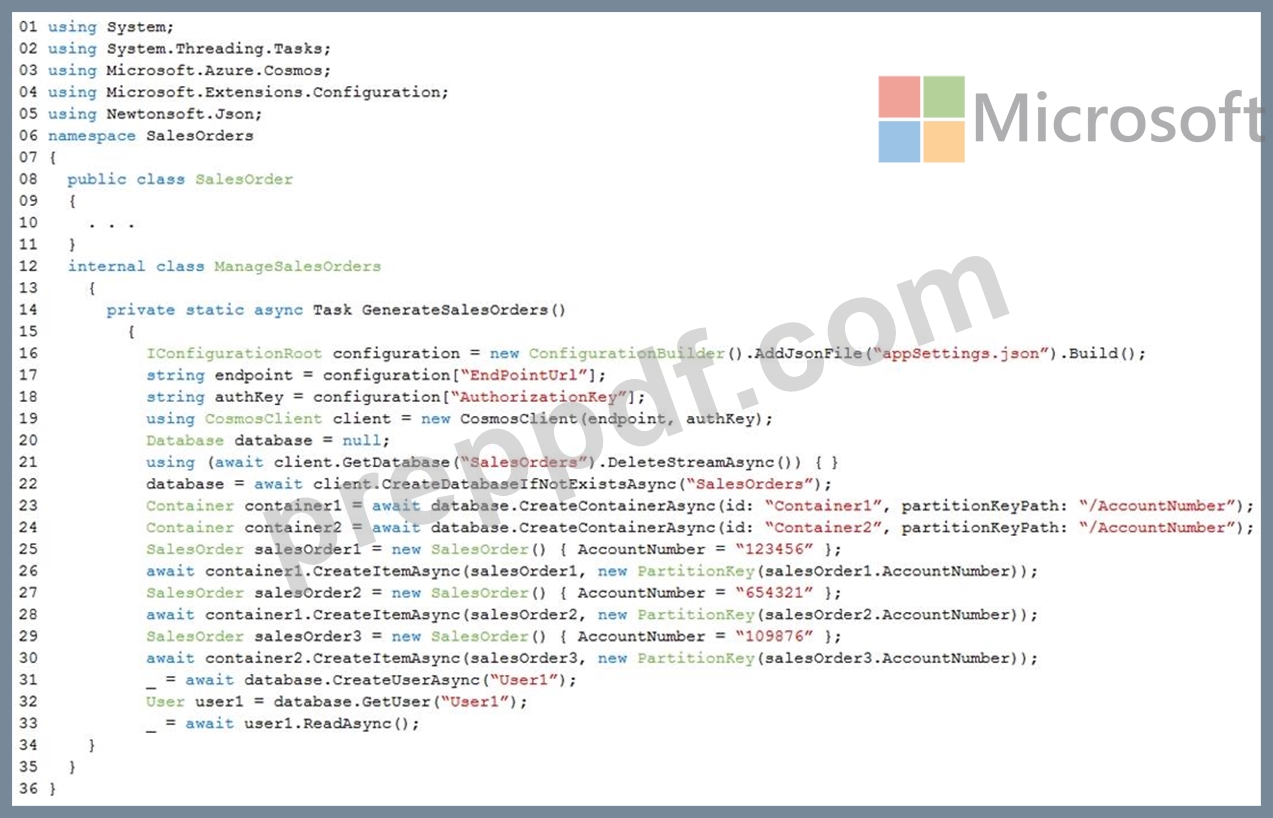
For each of the following statements, select Yes if the statement is true. Otherwise, select No.
NOTE: Each correct selection is worth one point.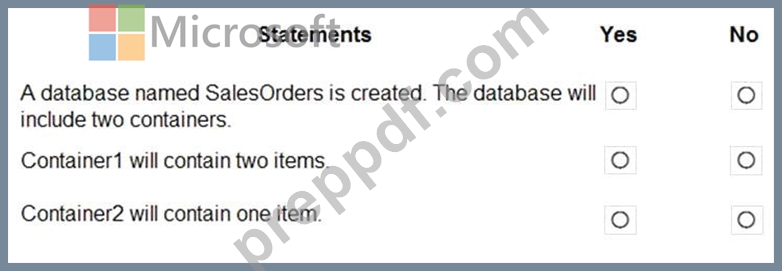
Answer:
Explanation: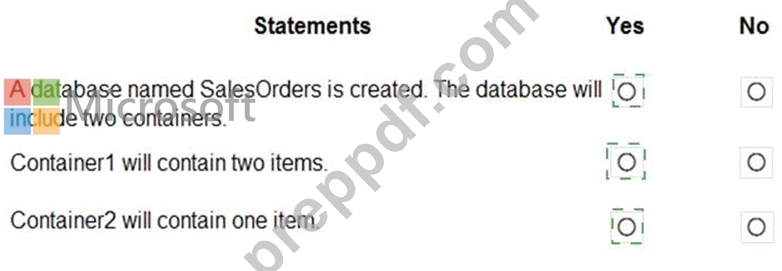
Explanation
Graphical user interface, text, application Description automatically generated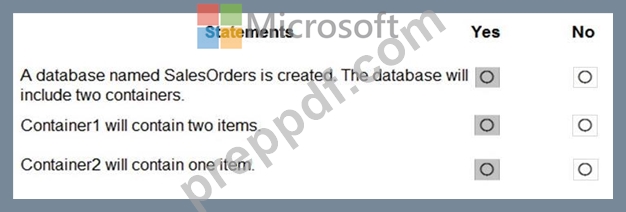
Box 1: Yes
The createDatabaseIfNotExistsAsync method checks if a database exists, and if it doesn't, create it.
The Database.CreateContainerAsync method creates a container as an asynchronous operation in the Azure Cosmos service.
Box 2: Yes
The CosmosContainer.CreateItemAsync method creates an item as an asynchronous operation in the Azure Cosmos service.
Box 3: Yes
Reference:
https://docs.microsoft.com/en-us/dotnet/api/microsoft.azure.cosmos.cosmosclient.createdatabaseifnotexistsasync
https://docs.microsoft.com/en-us/dotnet/api/microsoft.azure.cosmos.database.createcontainerasync
https://docs.microsoft.com/en-us/dotnet/api/azure.cosmos.cosmoscontainer.createitemasync
NEW QUESTION # 208
Note: This question is part of a series of questions that present the same scenario. Each question in the series contains a unique solution that might meet the stated goals. Some question sets might have more than one correct solution, while others might not have a correct solution.
After you answer a question in this section, you will NOT be able to return to it. As a result, these questions will not appear on the review screen.
You have an Azure App Service web app named WebApp1 and an Azure Functions app named Function 1.
WebApp1 is associated with an Application Insights instance named appinsights1.
You configure a web test and a corresponding alert for WebApp1 in appinsights1. Each alert triggers a delivery of email to your mailbox.
You need to ensure that each alert also triggers execution of Function1.
Solution: Configure an Application Insights funnel.
Does the solution meet the goal?
- A. Yes
- B. No
Answer: A
NEW QUESTION # 209
You develop an Azure solution that uses Cosmos DB.
The current Cosmos DB container must be replicated and must use a partition key that is optimized for queries.
You need to implement a change feed processor solution.
Which change feed processor components should you use? To answer, drag the appropriate components to the correct requirements. Each component may be used once, more than once, or not at all. You may need to drag the split bar between panes or scroll to view the content.
NOTE: Each correct selection is worth one point.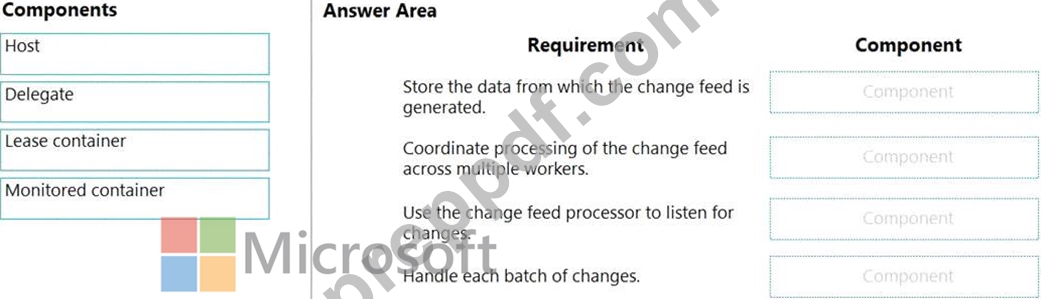
Answer:
Explanation: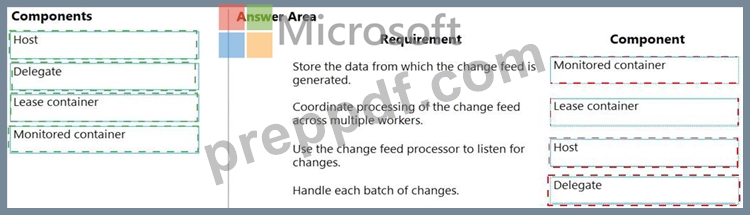
Explanation
Graphical user interface, application Description automatically generated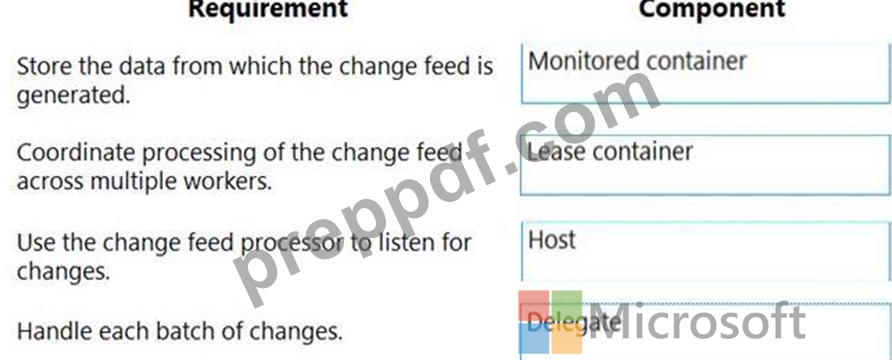
Box 1: The monitored container
The monitored container has the data from which the change feed is generated. Any inserts and updates to the monitored container are reflected in the change feed of the container.
Box 2: The lease container
The lease container acts as a state storage and coordinates processing the change feed across multiple workers.
The lease container can be stored in the same account as the monitored container or in a separate account.
Box 3: The host: A host is an application instance that uses the change feed processor to listen for changes.
Multiple instances with the same lease configuration can run in parallel, but each instance should have a different instance name.
Box 4: The delegate
The delegate is the code that defines what you, the developer, want to do with each batch of changes that the change feed processor reads.
Reference:
https://docs.microsoft.com/en-us/azure/cosmos-db/change-feed-processor
NEW QUESTION # 210
You are developing a service where customers can report news events from a browser using Azure Web PubSub. The service is implemented as an Azure App that the JSON WebSocket suprotocol to receive news events.
You need to implement the bindings for the Azure Function App.
How should you configure the binding? To answer, select the appropriate options in the answer area.
Note: Each Correct Selection in worth one point.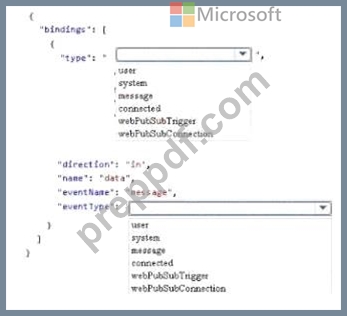
Answer:
Explanation: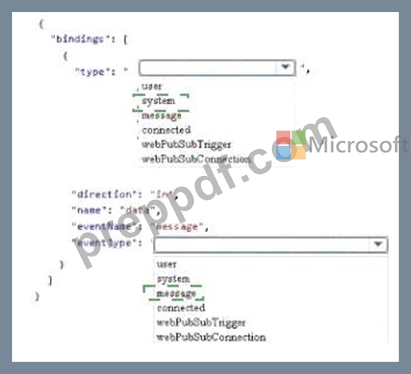
Explanation
Graphical user interface, text, application, chat or text message Description automatically generated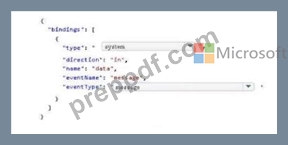
NEW QUESTION # 211
You develop a website. You plan to host the website in Azure. You expect the website to experience high traffic volumes after it is published.
You must ensure that the website remains available and responsive while minimizing cost.
You need to deploy the website.
What should you do?
- A. Deploy the website to a virtual machine. Configure a Scale Set to increase the virtual machine instance count when the CPU load is high.
- B. Deploy the website to an App Service that uses the Standard service tier. Configure the App service plan to automatically scale when the CPU load is high.
- C. Deploy the website to an App Service that uses the Shared service tier. Configure the App service plan to automatically scale when the CPU load is high.
- D. Deploy the website to a virtual machine. Configure the virtual machine to automatically scale when the CPU load is high.
Answer: B
Explanation:
Windows Azure Web Sites (WAWS) offers 3 modes: Standard, Free, and Shared.
Standard mode carries an enterprise-grade SLA (Service Level Agreement) of 99.9% monthly, even for sites with just one instance.
Standard mode runs on dedicated instances, making it different from the other ways to buy Windows Azure Web Sites.
Incorrect Answers:
B: Shared and Free modes do not offer the scaling flexibility of Standard, and they have some important limits.
Shared mode, just as the name states, also uses shared Compute resources, and also has a CPU limit.
So, while neither Free nor Shared is likely to be the best choice for your production environment due to these limits.
NEW QUESTION # 212
You have an app that stores player scores for an online game. The app stores data in Azure tables using a class named PlayerScore as the table entity. The table is populated with 100,000 records.
You are reviewing the following section of code that is intended to retrieve 20 records where the player score exceeds 15,000. (Line numbers are included for reference only.)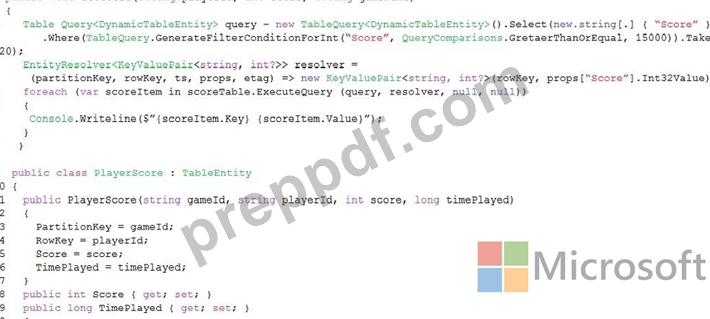
You have the following code. (Line numbers are included for reference only.) You store customer information in an Azure Cosmos database. The following data already exists in the database:
For each of the following statements, select Yes if the statement is true. Otherwise, select No.
NOTE: Each correct selection is worth one point.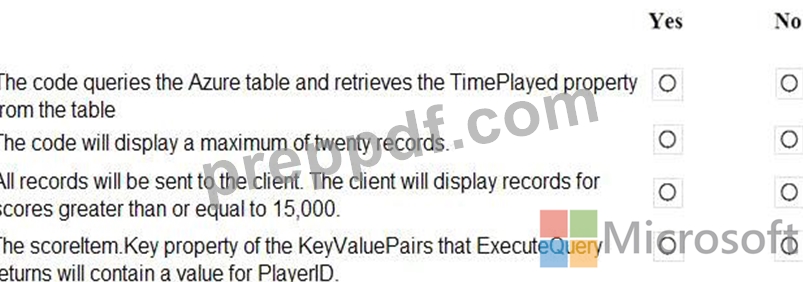
Answer:
Explanation: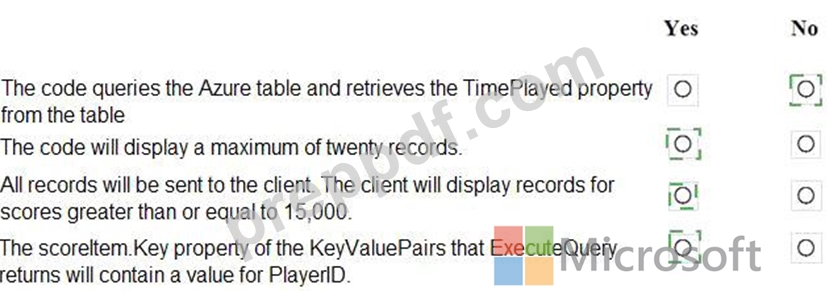
Explanation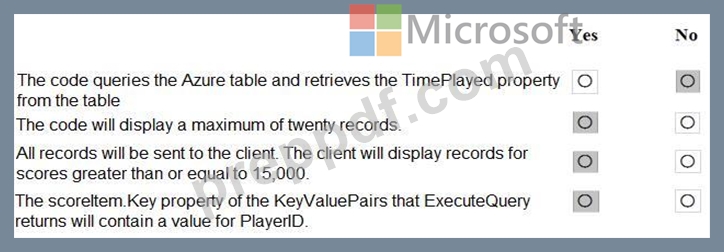
Box 1: No
Box 2: Yes
The TableQuery.Take method defines the upper bound for the number of entities the query returns.
Example:
query.Take(10);
Box 3: Yes
Box 4: Yes
References:
https://www.vkinfotek.com/azureqa/how-do-i-query-azure-table-storage-using-tablequery-class.html
NEW QUESTION # 213
Which of the following best describes the role of the Orchestrator function in a workflow?
- A. It's used as the basic unit of work (actions and tasksin a durable function orchestration.
- B. It's used for describing how actions are executed and the order in which actions are executed.
- C. It's the entry point for creating an instance of a Durable Functions orchestration.
Answer: B
NEW QUESTION # 214
You develop a containerized application. You plan to deploy the application to a new Azure Container instance by using a third-party continuous integration and continuous delivery (CI/CD) utility.
The deployment must be unattended and include all application assets. The third-party utility must only be able to push and pull images from the registry. The authentication must be managed by Azure Active Directory (Azure AD). The solution must use the principle of least privilege.
You need to ensure that the third-party utility can access the registry.
Which authentication options should you use? To answer, select the appropriate options in the answer area.
NOTE: Each correct selection is worth one point.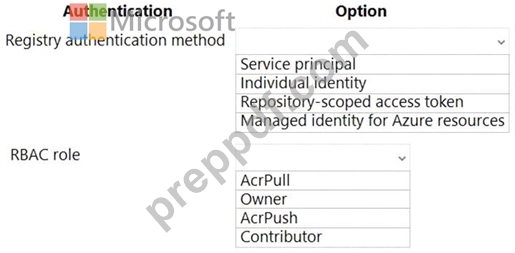
Answer:
Explanation: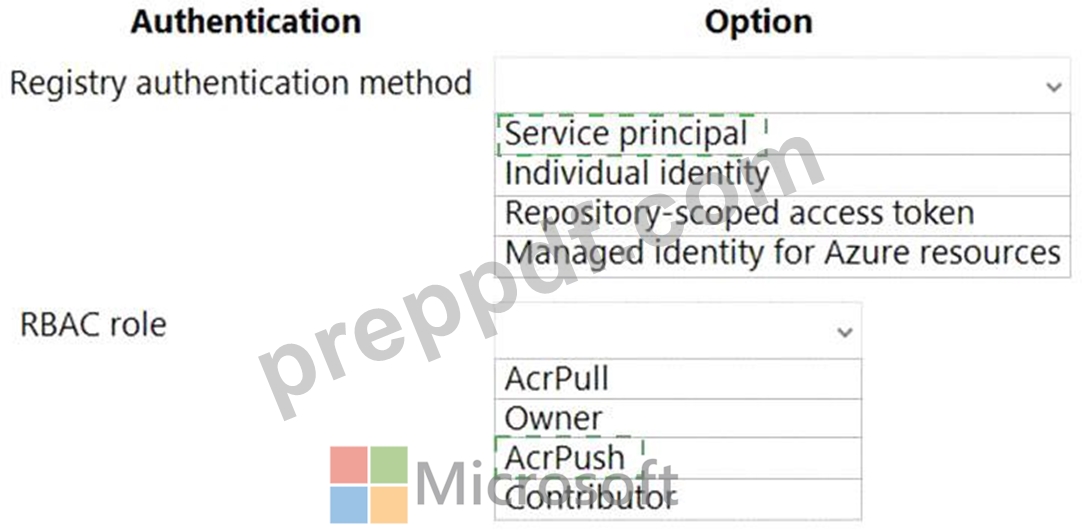
Explanation
Graphical user interface, text, application, table Description automatically generated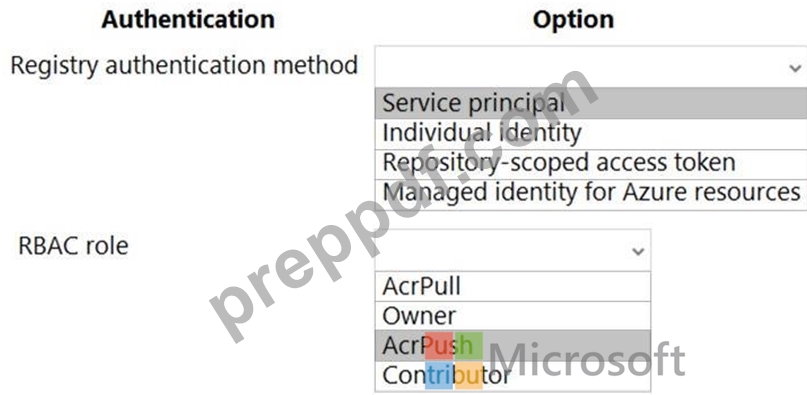
Box 1: Service principal
Applications and container orchestrators can perform unattended, or "headless," authentication by using an Azure Active Directory (Azure AD) service principal.
Box 2: AcrPush
AcrPush provides pull/push permissions only and meets the principle of least privilege.
Reference:
https://docs.microsoft.com/en-us/azure/container-registry/container-registry-authentication?tabs=azure-cli
https://docs.microsoft.com/en-us/azure/container-registry/container-registry-roles?tabs=azure-cli
NEW QUESTION # 215
Contoso, Ltd. provides an API to customers by using Azure API Management (APIM). The API authorizes users with a JWT token.
You must implement response caching for the APIM gateway. The caching mechanism must detect the user ID of the client that accesses data for a given location and cache the response for that user ID.
You need to add the following policies to the policies file:
* a set-variable policy to store the detected user identity
* a cache-lookup-value policy
* a cache-store-value policy
* a find-and-replace policy to update the response body with the user profile information To which policy section should you add the policies? To answer, drag the appropriate sections to the correct policies. Each section may be used once, more than once, or not at all. You may need to drag the split bar between panes or scroll to view content NOTE: Each correct selection is worth one point
Answer:
Explanation:
Explanation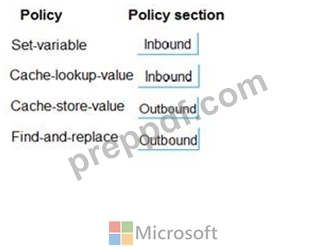
Box 1: Inbound.
A set-variable policy to store the detected user identity.
Example:
<policies>
<inbound>
<!-- How you determine user identity is application dependent -->
<set-variable
name="enduserid"
value="@(context.Request.Headers.GetValueOrDefault("Authorization","").Split(' ')[1].AsJwt()?.Subject)" /> Box 2: Inbound A cache-lookup-value policy Example:
<inbound>
<base />
<cache-lookup vary-by-developer="true | false" vary-by-developer-groups="true | false" downstream-caching-type="none | private | public" must-revalidate="true | false">
<vary-by-query-parameter>parameter name</vary-by-query-parameter> <!-- optional, can repeated several times -->
</cache-lookup>
</inbound>
Box 3: Outbound
A cache-store-value policy.
Example:
<outbound>
<base />
<cache-store duration="3600" />
</outbound>
Box 4: Outbound
A find-and-replace policy to update the response body with the user profile information.
Example:
<outbound>
<!-- Update response body with user profile-->
<find-and-replace
from='"$userprofile$"'
to="@((string)context.Variables["userprofile"])" />
<base />
</outbound>
Reference:
https://docs.microsoft.com/en-us/azure/api-management/api-management-caching-policies
https://docs.microsoft.com/en-us/azure/api-management/api-management-sample-cache-by-key
NEW QUESTION # 216
You create the following PowerShell script:
For each of the following statements, select Yes if the statement is true. Otherwise, select No, NOTE: Each correct selection is worth one point.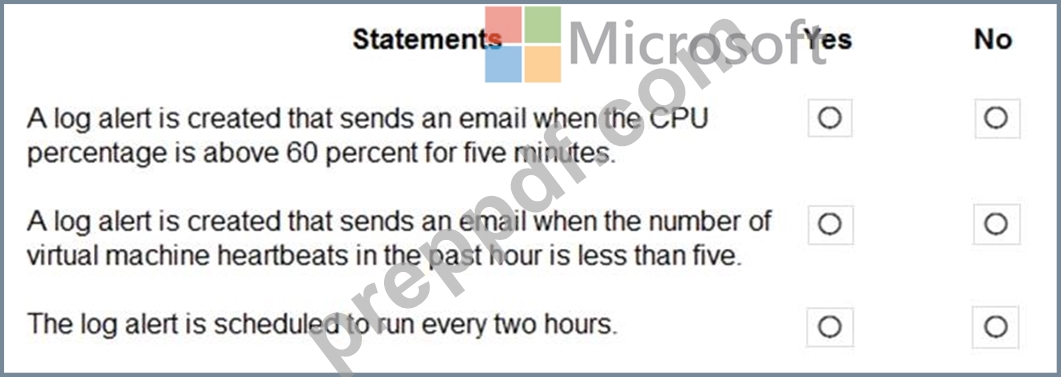
Answer:
Explanation: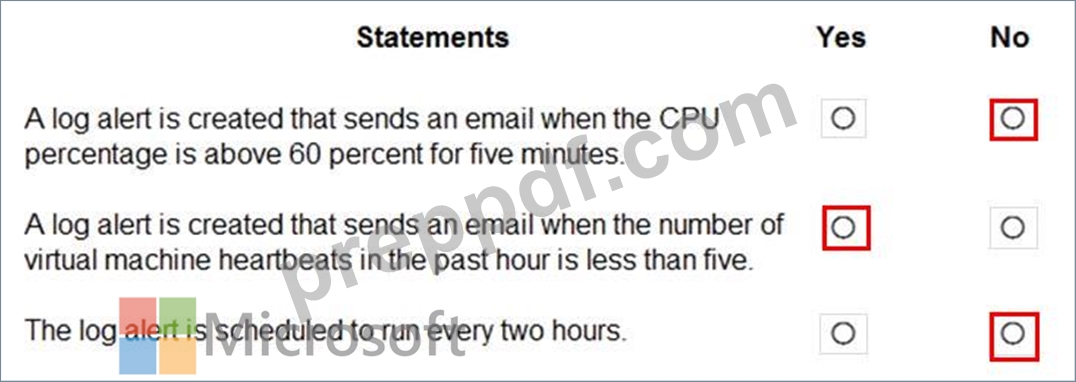
Reference:
https://docs.microsoft.com/en-us/powershell/module/az.monitor/new-azscheduledqueryrule
https://docs.microsoft.com/en-us/powershell/module/az.monitor/new-azscheduledqueryruletriggercondition
NEW QUESTION # 217
You are working for Contoso, Ltd.
You define an API Policy object by using the following XML markup: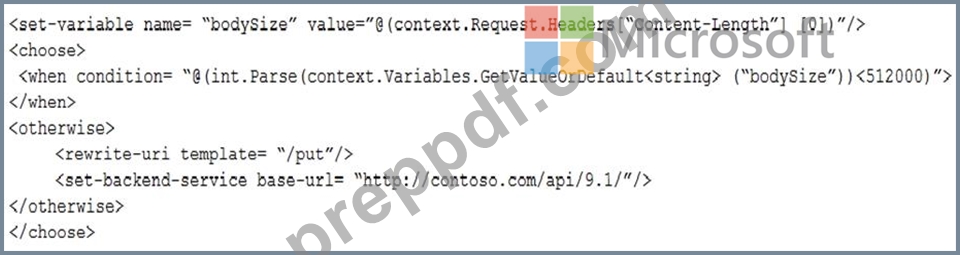
For each of the following statements, select Yes if the statement is true. Otherwise, select No.
NOTE: Each correct selection is worth one point.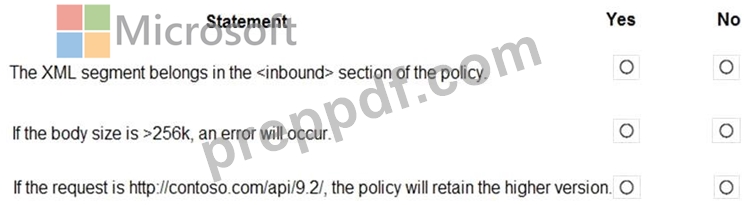
Answer:
Explanation: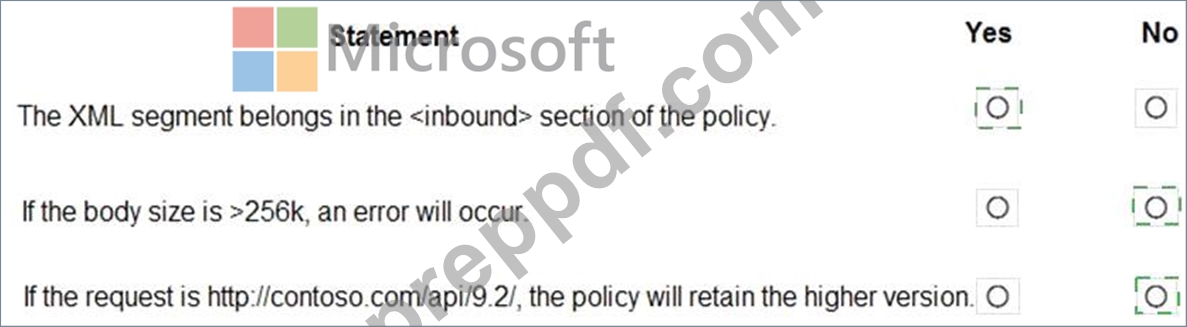
Explanation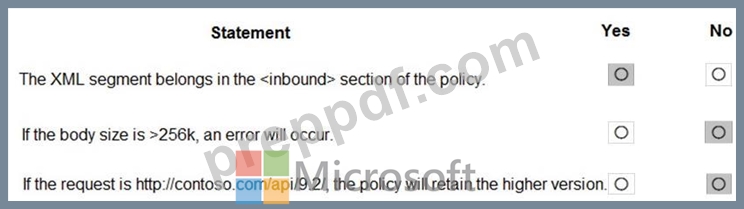
Box 1: Yes
Use the set-backend-service policy to redirect an incoming request to a different backend than the one specified in the API settings for that operation. Syntax: <set-backend-service base-url="base URL of the backend service" /> Box 2: No The condition is on 512k, not on 256k.
Box 3: No
The set-backend-service policy changes the backend service base URL of the incoming request to the one specified in the policy.
Reference:
https://docs.microsoft.com/en-us/azure/api-management/api-management-transformation-policies
NEW QUESTION # 218
You are implementing an order processing system. A point of sale application publishes orders to topics in an Azure Service Bus queue. The label property for the topic includes the following data: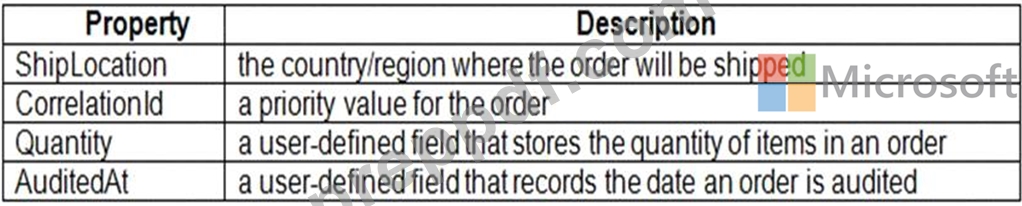
The system has the following requirements for subscriptions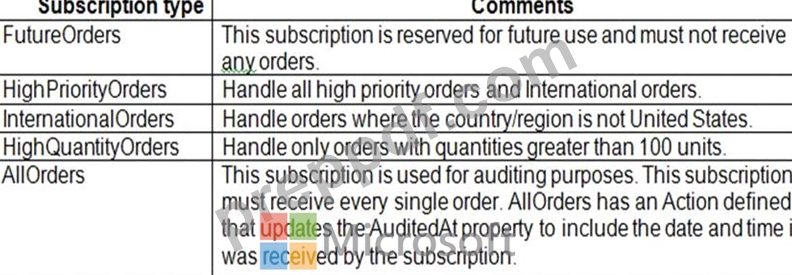
You need to implement filtering and maximize throughput while evaluating filters.
Which filter types should you implement? To answer, drag the appropriate filter types to the correct subscriptions. Each filter type may be used once, more than once, or not at all. You may need to drag the split bar between panes or scroll to view content.
NOTE: Each correct selection is worth one point.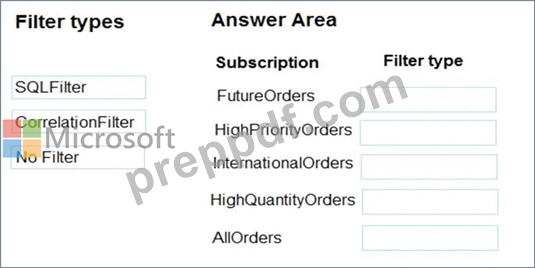
Answer:
Explanation: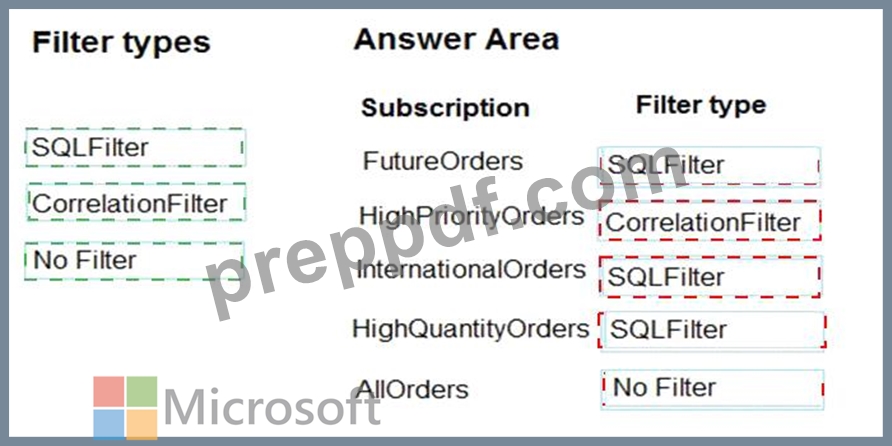
Explanation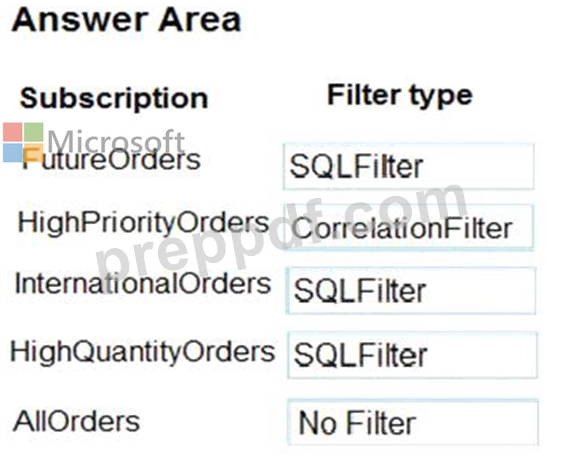
FutureOrders: SQLFilter
HighPriortyOrders: CorrelationFilter
CorrelationID only
InternationalOrders: SQLFilter
Country NOT USA requires an SQL Filter
HighQuantityOrders: SQLFilter
Need to use relational operators so an SQL Filter is needed.
AllOrders: No Filter
SQL Filter: SQL Filters - A SqlFilter holds a SQL-like conditional expression that is evaluated in the broker against the arriving messages' user-defined properties and system properties. All system properties must be prefixed with sys. in the conditional expression. The SQL-language subset for filter conditions tests for the existence of properties (EXISTS), as well as for null-values (IS NULL), logical NOT/AND/OR, relational operators, simple numeric arithmetic, and simple text pattern matching with LIKE.
Correlation Filters - A CorrelationFilter holds a set of conditions that are matched against one or more of an arriving message's user and system properties. A common use is to match against the CorrelationId property, but the application can also choose to match against ContentType, Label, MessageId, ReplyTo, ReplyToSessionId, SessionId, To, and any user-defined properties. A match exists when an arriving message's value for a property is equal to the value specified in the correlation filter. For string expressions, the comparison is case-sensitive. When specifying multiple match properties, the filter combines them as a logical AND condition, meaning for the filter to match, all conditions must match.
Boolean filters - The TrueFilter and FalseFilter either cause all arriving messages (true) or none of the arriving messages (false) to be selected for the subscription.
References:
https://docs.microsoft.com/en-us/azure/service-bus-messaging/topic-filters
NEW QUESTION # 219
Contoso, Ltd. provides an API to customers by using Azure API Management (APIM). The API authorizes users with a JWT token.
You must implement response caching for the APIM gateway. The caching mechanism must detect the user ID of the client that accesses data for a given location and cache the response for that user ID.
You need to add the following policies to the policies file:
* a set-variable policy to store the detected user identity
* a cache-lookup-value policy
* a cache-store-value policy
* a find-and-replace policy to update the response body with the user profile information To which policy section should you add the policies? To answer, drag the appropriate sections to the correct policies. Each section may be used once, more than once, or not at all. You may need to drag the split bar between panes or scroll to view content NOTE: Each correct selection is worth one point
Answer:
Explanation:
Reference:
https://docs.microsoft.com/en-us/azure/api-management/api-management-caching-policies
https://docs.microsoft.com/en-us/azure/api-management/api-management-sample-cache-by-key
NEW QUESTION # 220
You are validating the configuration of an Azure Search indexer.
The service has been configured with an indexer that uses the Import Data option. The index is configured using options as shown in the Index Configuration exhibit. (Click the Index Configuration tab.)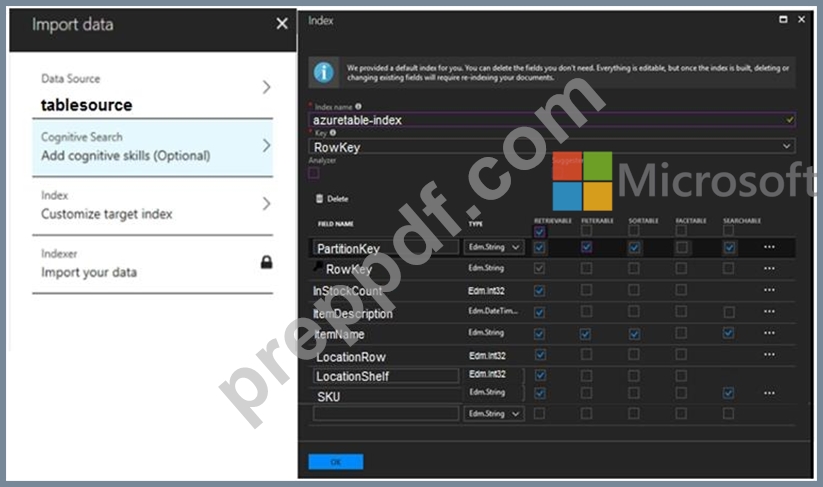
You use an Azure table as the data source for the import operation. The table contains three records with item inventory data that matches the fields in the Storage data exhibit. These records were imported when the index was created. (Click the Storage Data tab.) When users search with no filter, all three records are displayed.
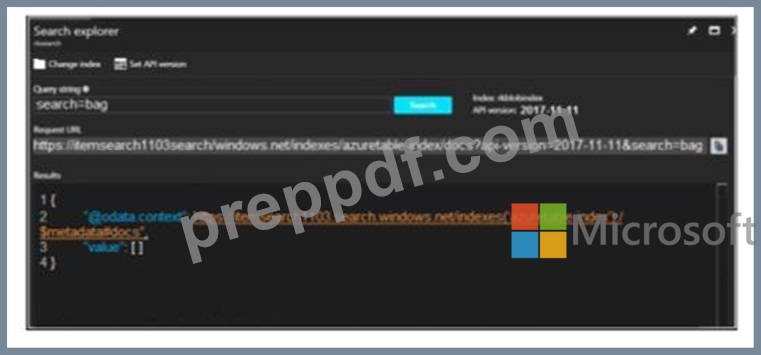
When users search for items by description, Search explorer returns no records. The Search Explorer exhibit shows the query and results for a test. In the test, a user is trying to search for all items in the table that have a description that contains the word bag. (Click the Search Explorer tab.) You need to resolve the issue.
For each of the following statements, select Yes if the statement is true. Otherwise, select No.
NOTE: Each correct selection is worth one point.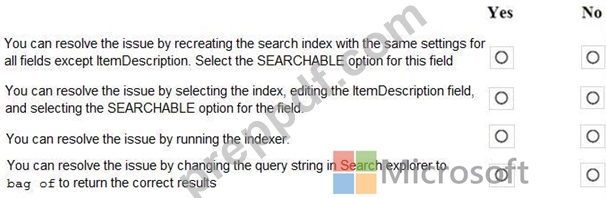
Answer:
Explanation: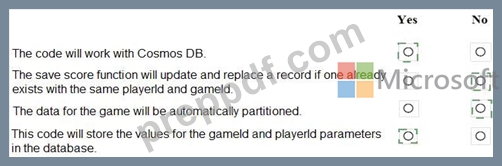
Explanation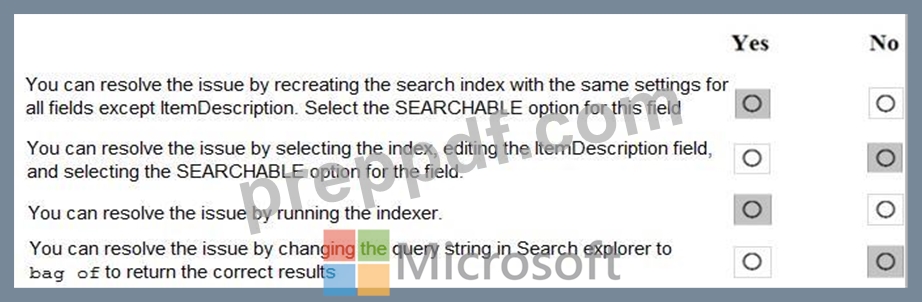
Box 1: Yes
The ItemDescription field in not searchable.
Box 2: No
The ItemDescription field in not searchable, but we would need to recreate the index.
Box 3: Yes
An indexer in Azure Search is a crawler that extracts searchable data and metadata from an external Azure data source and populates an index based on field-to-field mappings between the index and your data source.
This approach is sometimes referred to as a 'pull model' because the service pulls data in without you having to write any code that adds data to an index.
Box 4: No
References:
https://docs.microsoft.com/en-us/azure/search/search-what-is-an-index
https://docs.microsoft.com/en-us/azure/search/search-indexer-overview
NEW QUESTION # 221
You need to add code at line PC32 in Processing.cs to implement the GetCredentials method in the Processing class.
How should you complete the code? To answer, drag the appropriate code segments to the correct locations.
Each code segment may be used once, more than once, or not at all. You may need to drag the split bar between panes or scroll to view content.
NOTE: Each correct selection is worth one point.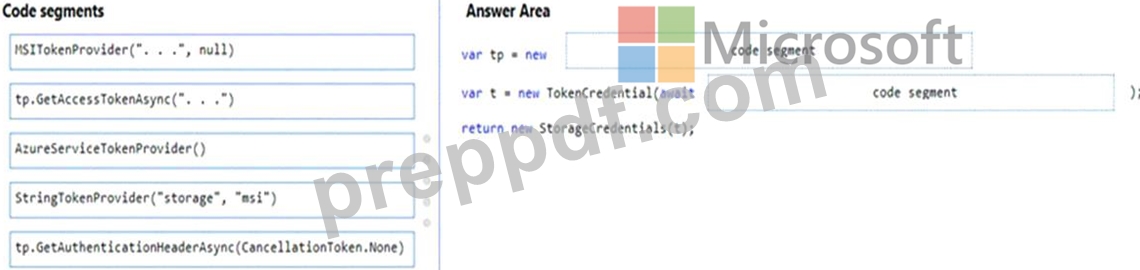
Answer:
Explanation: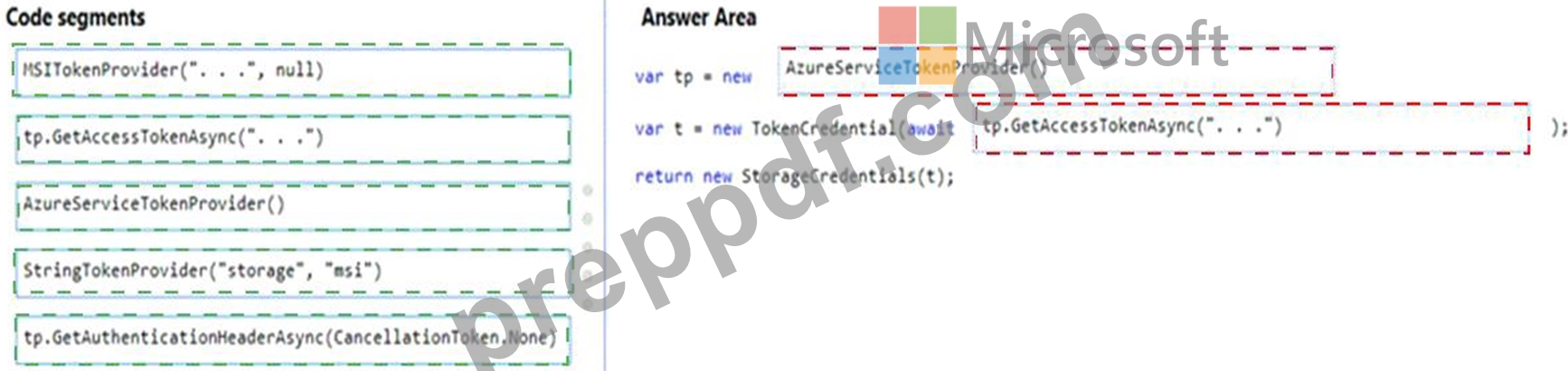
Explanation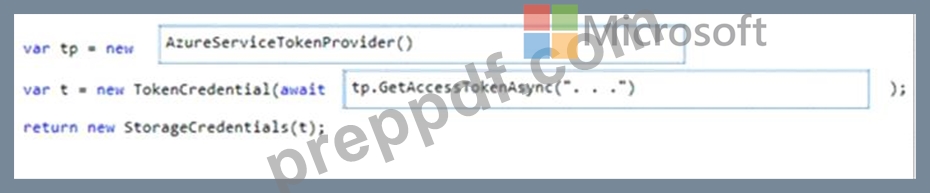
Box 1: AzureServiceTokenProvider()
Box 2: tp.GetAccessTokenAsync("..")
Acquiring an access token is then quite easy. Example code:
private async Task<string> GetAccessTokenAsync()
{
var tokenProvider = new AzureServiceTokenProvider();
return await tokenProvider.GetAccessTokenAsync("https://storage.azure.com/");
}
Reference:
https://joonasw.net/view/azure-ad-authentication-with-azure-storage-and-managed-service-identity
Topic 6, Coho Winery
Case study
This is a case study. Case studies are not timed separately. You can use as much exam time as you would like to complete each case. However, there may be additional case studies and sections on this exam. You must manage your time to ensure that you are able to complete all questions included on this exam in the time provided.
To answer the questions included in a case study, you will need to reference information that is provided in the case study. Case studies might contain exhibits and other resources that provide more information about the scenario that is described in the case study. Each question is independent of the other questions in this case study.
At the end of this case study, a review screen will appear. This screen allows you to review your answers and to make changes before you move to the next section of the exam. After you begin a new section, you cannot return to this section.
To start the case study
To display the first question in this case study, click the button. Use the buttons in the left pane to explore the content of the case study before you answer the questions. Clicking these buttons displays information such as business requirements, existing environment, and problem statements. When you are ready to answer a question, click the LabelMaker app Coho Winery produces, bottles, and distributes a variety of wines globally. You are a developer implementing highly scalable and resilient applications to support online order processing by using Azure solutions.
Coho Winery has a LabelMaker application that prints labels for wine bottles. The application sends data to several printers. The application consists of five modules that run independently on virtual machines (VMs).
Coho Winery plans to move the application to Azure and continue to support label creation.
External partners send data to the LabelMaker application to include artwork and text for custom label designs.
Requirements. Data
You identify the following requirements for data management and manipulation:
Order data is stored as nonrelational JSON and must be queried using SQL.
Changes to the Order data must reflect immediately across all partitions. All reads to the Order data must fetch the most recent writes.
Requirements. Security
You have the following security requirements:
Users of Coho Winery applications must be able to provide access to documents, resources, and applications to external partners.
External partners must use their own credentials and authenticate with their organization's identity management solution.
External partner logins must be audited monthly for application use by a user account administrator to maintain company compliance.
Storage of e-commerce application settings must be maintained in Azure Key Vault.
E-commerce application sign-ins must be secured by using Azure App Service authentication and Azure Active Directory (AAD).
Conditional access policies must be applied at the application level to protect company content.
The LabelMaker application must be secured by using an AAD account that has full access to all namespaces of the Azure Kubernetes Service (AKS) cluster.
Requirements. LabelMaker app
Azure Monitor Container Health must be used to monitor the performance of workloads that are deployed to Kubernetes environments and hosted on Azure Kubernetes Service (AKS).
You must use Azure Container Registry to publish images that support the AKS deployment.
Architecture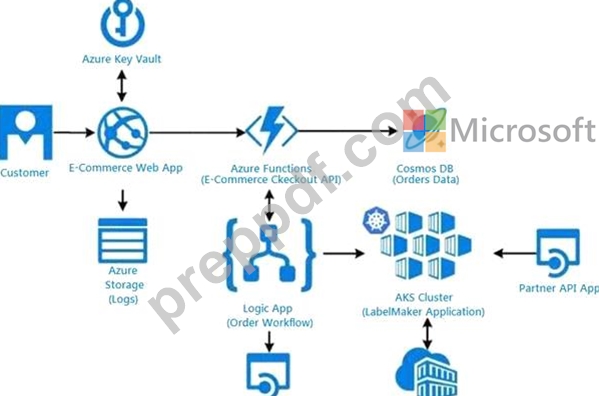
Issues
Calls to the Printer API App fail periodically due to printer communication timeouts.
Printer communication timeouts occur after 10 seconds. The label printer must only receive up to 5 attempts within one minute.
The order workflow fails to run upon initial deployment to Azure.
Order.json
Relevant portions of the app files are shown below. Line numbers are included for reference only.
This JSON file contains a representation of the data for an order that includes a single item.
Order.json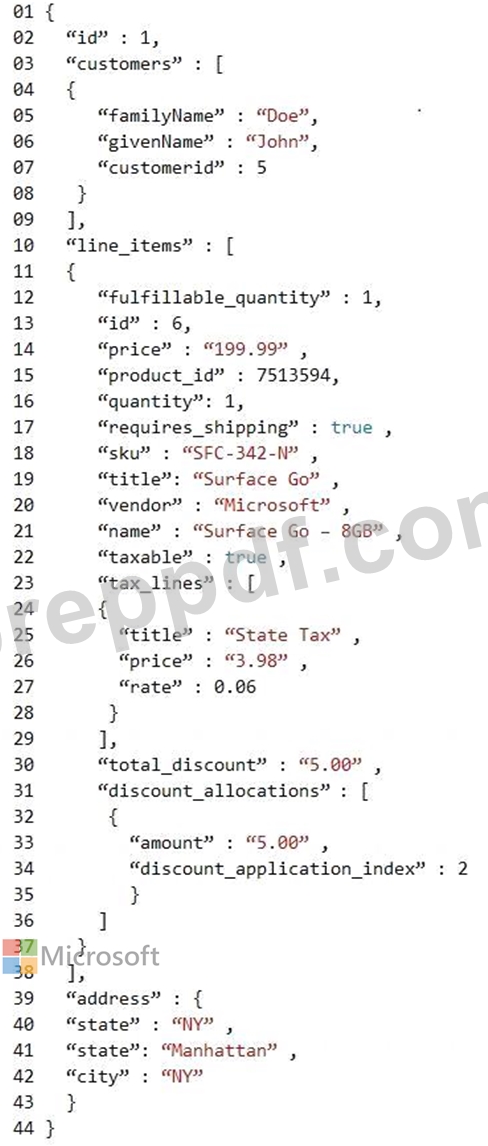
NEW QUESTION # 222
You are developing a solution that uses the Azure Storage Client library for .NET. You have the following code: (Line numbers are included for reference only.)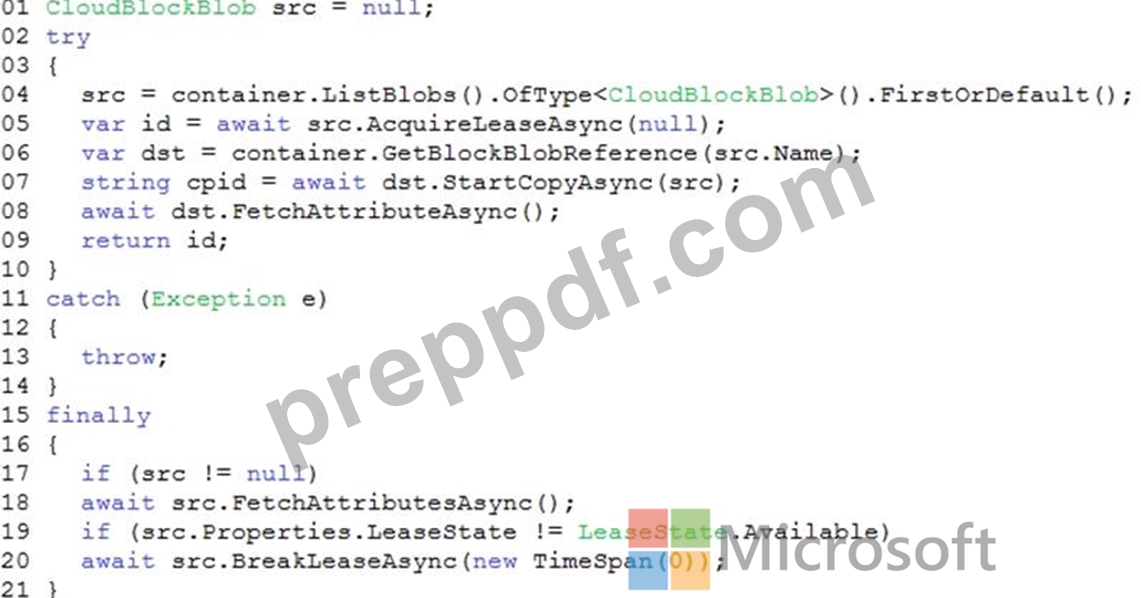
For each of the following statements, select Yes if the statement is true. Otherwise, select No.
NOTE: Each correct selection is worth one point.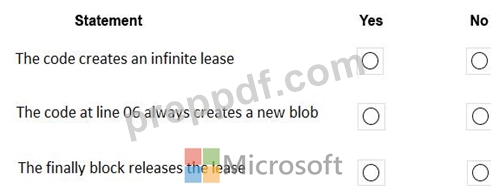
Answer:
Explanation: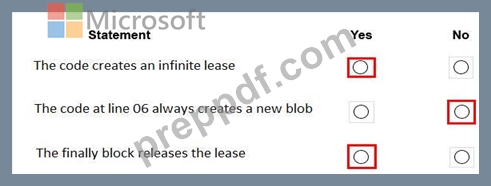
Reference:
https://docs.microsoft.com/en-us/dotnet/api/microsoft.azure.storage.blob.cloudblobcontainer.acquireleaseasync
https://docs.microsoft.com/en-us/dotnet/api/microsoft.azure.storage.blob.cloudblobcontainer.getblockblobreference
https://docs.microsoft.com/en-us/dotnet/api/microsoft.azure.storage.blob.cloudblobcontainer.breakleaseasync
NEW QUESTION # 223
You are debugging an application that is running on Azure Kubernetes cluster named cluster1. The cluster uses Azure Monitor for containers to monitor the cluster.
The application has sticky sessions enabled on the ingress controller.
Some customers report a large number of errors in the application over the last 24 hours.
You need to determine on which virtual machines (VMs) the errors are occurring.
How should you complete the Azure Monitor query? To answer, select the appropriate options in the answer area.
NOTE: Each correct selection is worth one point.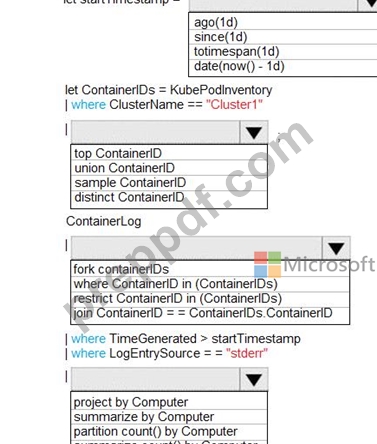
Answer:
Explanation: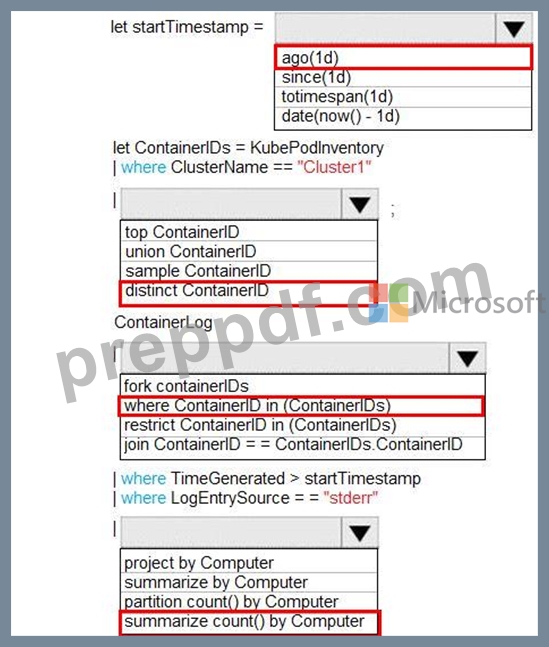
Reference:
https://docs.microsoft.com/en-us/azure/azure-monitor/log-query/get-started-queries
https://docs.microsoft.com/en-us/azure/azure-monitor/log-query/query-optimization
NEW QUESTION # 224
You are developing an Azure Function App. You develop code by using a language that is not supported by the Azure Function App host. The code language supports HTTP primitives.
You must deploy the code to a production Azure Function App environment.
You need to configure the app for deployment.
Which configuration values should you use? To answer, select the appropriate options in the answer area.
NOTE: Each correct selection is worth one point.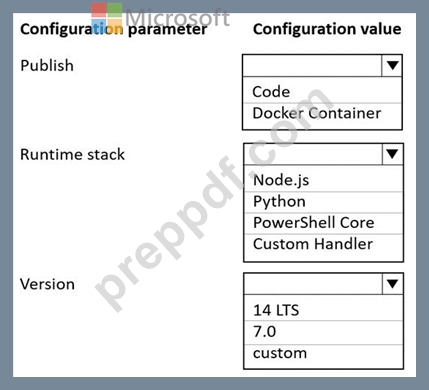
Answer:
Explanation: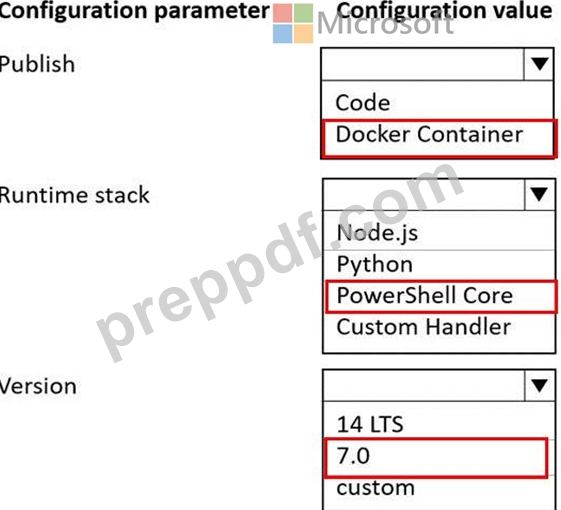
Reference:
https://docs.microsoft.com/en-us/azure/azure-functions/functions-create-function-linux-custom-image
https://docs.microsoft.com/en-us/powershell/azure/install-az-ps?view=azps-7.1.0
NEW QUESTION # 225
You are developing an application to retrieve user profile information. The application will use the Microsoft Graph SDK.
The app must retrieve user profile information by using a Microsoft Graph API call.
You need to call the Microsoft Graph API from the application.
In which order should you perform the actions? To answer, move all actions from the list of actions to the answer area and arrange them in the correct order.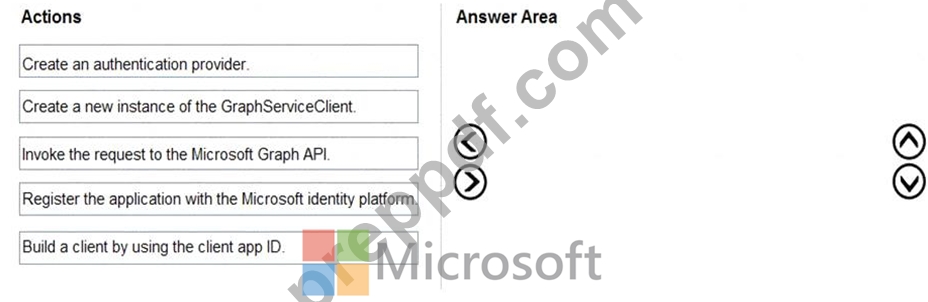
Answer:
Explanation: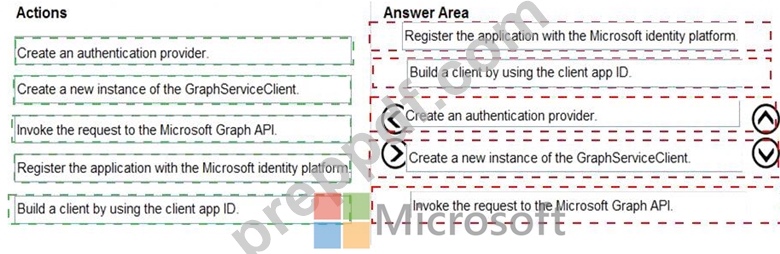
Explanation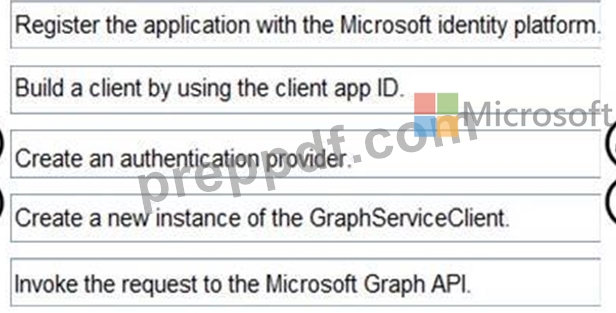
Table Description automatically generated
Step 1: Register the application with the Microsoft identity platform.
To authenticate with the Microsoft identity platform endpoint, you must first register your app at the Azure app registration portal Step 2: Build a client by using the client app ID Step 3: Create an authentication provider Create an authentication provider by passing in a client application and graph scopes.
Code example:
DeviceCodeProvider authProvider = new DeviceCodeProvider(publicClientApplication, graphScopes);
// Create a new instance of GraphServiceClient with the authentication provider.
GraphServiceClient graphClient = new GraphServiceClient(authProvider);
Step 4: Create a new instance of the GraphServiceClient
Step 5: Invoke the request to the Microsoft Graph API
Reference:
https://docs.microsoft.com/en-us/graph/auth-v2-service
https://docs.microsoft.com/en-us/graph/sdks/create-client
NEW QUESTION # 226
You are debugging an application that is running on Azure Kubernetes cluster named cluster1. The cluster uses Azure Monitor for containers to monitor the cluster.
The application has sticky sessions enabled on the ingress controller.
Some customers report a large number of errors in the application over the last 24 hours.
You need to determine on which virtual machines (VMs) the errors are occurring.
How should you complete the Azure Monitor query? To answer, select the appropriate options in the answer area.
NOTE: Each correct selection is worth one point.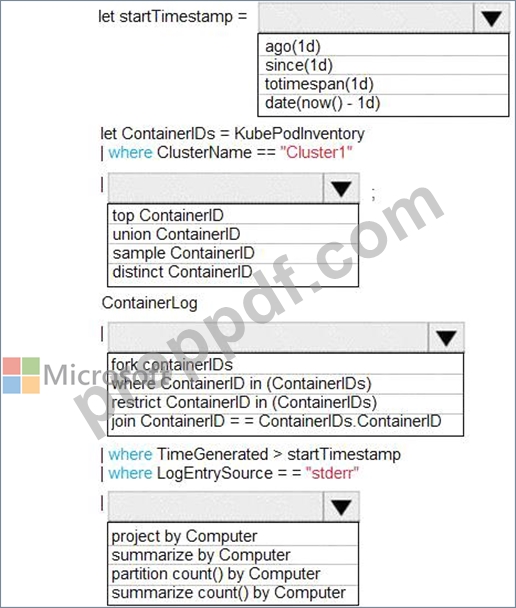
Answer:
Explanation: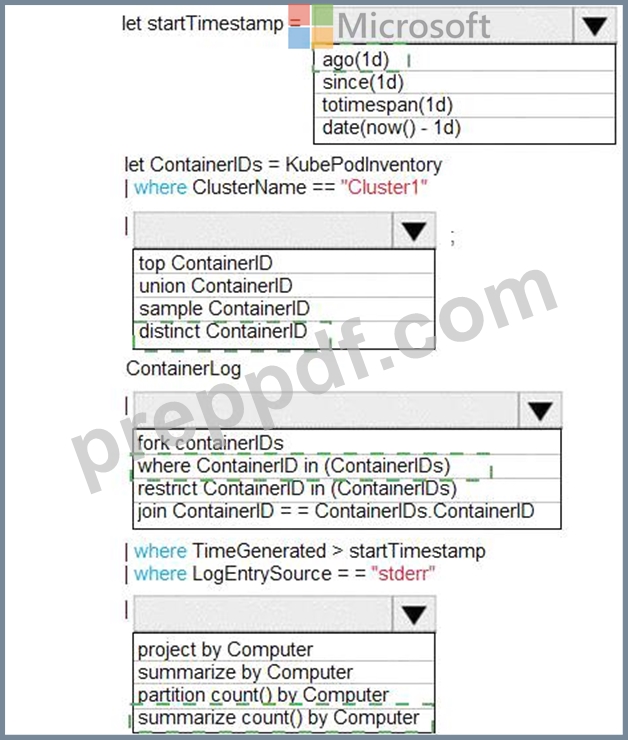
Explanation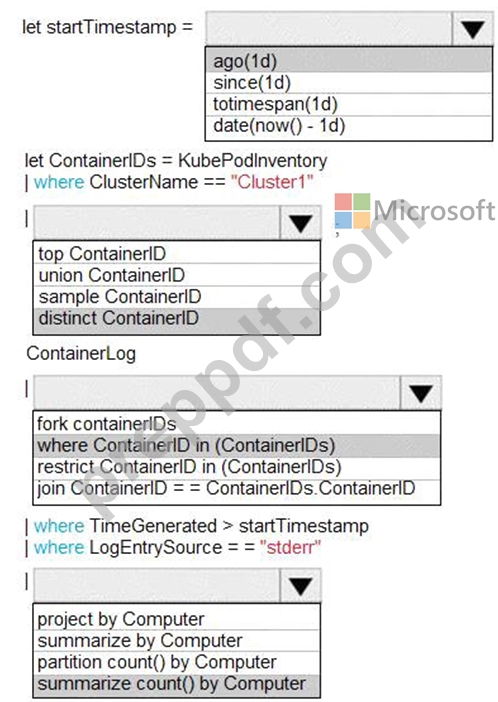
Box 1: ago(1d)
Box 2: distinct containerID
Box 3: where ContainerID in (ContainerIDs)
Box 4: summarize Count by Computer
Summarize: aggregate groups of rows
Use summarize to identify groups of records, according to one or more columns, and apply aggregations to them. The most common use of summarize is count, which returns the number of results in each group.
Reference:
https://docs.microsoft.com/en-us/azure/azure-monitor/log-query/get-started-queries
https://docs.microsoft.com/en-us/azure/azure-monitor/log-query/query-optimization
NEW QUESTION # 227
Note: This question is part of a series of questions that present the same scenario. Each question in the series contains a unique solution. Determine whether the solution meets the stated goals.
You are developing and deploying several ASP.Net web applications to Azure App Service. You plan to save session state information and HTML output. You must use a storage mechanism with the following requirements:
* Share session state across all ASP.NET web applications
* Support controlled, concurrent access to the same session state data for multiple readers and a single writer
* Save full HTTP responses for concurrent requests
You need to store the information.
Proposed Solution: Deploy and configure Azure Cache for Redis. Update the web applications.
Does the solution meet the goal?
- A. Yes
- B. No
Answer: A
Explanation:
The session state provider for Azure Cache for Redis enables you to share session information between different instances of an ASP.NET web application.
The same connection can be used by multiple concurrent threads.
Redis supports both read and write operations.
The output cache provider for Azure Cache for Redis enables you to save the HTTP responses generated by an ASP.NET web application.
Note: Using the Azure portal, you can also configure the eviction policy of the cache, and control access to the cache by adding users to the roles provided. These roles, which define the operations that members can perform, include Owner, Contributor, and Reader. For example, members of the Owner role have complete control over the cache (including security) and its contents, members of the Contributor role can read and write information in the cache, and members of the Reader role can only retrieve data from the cache.
Reference:
https://docs.microsoft.com/en-us/azure/architecture/best-practices/caching
NEW QUESTION # 228
......
Microsoft AZ-204 Dumps - Secret To Pass in First Attempt: https://measureup.preppdf.com/Microsoft/AZ-204-prepaway-exam-dumps.html