

New NetSec-Generalist Dumps For Preparing Network Security Administrator Certified Palo Alto Networks Exam Well
Updated NetSec-Generalist Dumps Questions Are Available [2025] For Passing Palo Alto Networks Exam
Palo Alto Networks NetSec-Generalist Exam Syllabus Topics:
| Topic | Details |
|---|---|
| Topic 1 |
|
| Topic 2 |
|
| Topic 3 |
|
| Topic 4 |
|
| Topic 5 |
|
NEW QUESTION # 35
A security administrator is adding a new sanctioned cloud application to SaaS Data Security.
After authentication, how does the tool gain API access for monitoring?
- A. It transmits the configured SAML user profile to the cloud application for security event attribution.
- B. It establishes an encrypted key pair with the cloud application to safely transmit user data.
- C. It generates a certificate and sends it to the cloud application for TLS decryption and inspection.
- D. It receives a token from the cloud application for establishing and maintaining a secure connection.
Answer: D
Explanation:
When adding a new sanctioned cloud application to SaaS Data Security, the tool establishes API access by receiving an OAuth token or a similar type of token from the cloud application.
API Integration: The token allows the SaaS Data Security solution to authenticate itself with the cloud application, enabling secure monitoring and management of user activity, data flow, and security events.
Token Usage: The token maintains the connection between the SaaS application and the security tool, ensuring seamless communication while enforcing access policies and monitoring for anomalies.
Security: This method ensures that API access is secure and prevents unauthorized access to the cloud application.
Reference:
Palo Alto Networks SaaS Security API Documentation
OAuth Authentication and API Access
NEW QUESTION # 36
In which mode should an ION device be configured at a newly acquired site to allow site traffic to be audited without steering traffic?
- A. Control
- B. Disabled
- C. Analytics
- D. Access
Answer: C
Explanation:
An ION device (used in Prisma SD-WAN) must be configured in Analytics mode at a newly acquired site to audit traffic without steering it. This mode allows administrators to monitor network behavior without actively modifying traffic paths.
Why Analytics Mode is the Correct Choice?
Passively Observes Traffic
The ION device monitors and logs site traffic for analysis.
No active control over routing or traffic flow is applied.
Useful for Network Auditing Before Full Deployment
Analytics mode provides visibility into site traffic before committing to SD-WAN policy changes.
Helps identify optimization opportunities and troubleshoot connectivity before enabling traffic steering.
Other Answer Choices Analysis
(A) Access Mode - Enables active routing and steering of traffic, which is not desired for passive auditing.
(B) Control Mode - Actively controls traffic flows and enforces policies, not suitable for observation-only setups.
(C) Disabled Mode - The device would not function in this mode, making it useless for traffic monitoring.
Reference and Justification:
Firewall Deployment - Prisma SD-WAN ION devices must be placed in Analytics mode for initial audits.
Zero Trust Architectures - Helps assess security risks before enabling active controls.
Thus, Analytics Mode (D) is the correct answer, as it allows auditing of site traffic without traffic steering.
NEW QUESTION # 37
Which Cloud-Delivered Security Services (CDSS) solution is required to configure and enable Advanced DNS Security?
- A. Advanced WildFire
- B. Advanced Threat Prevention
- C. Advanced URL Filtering
- D. Enterprise SaaS Security
Answer: B
NEW QUESTION # 38
Based on the image below, which source IP address will be seen in the data filtering logs of the Cloud NGFW for AWS with the default rulestack settings?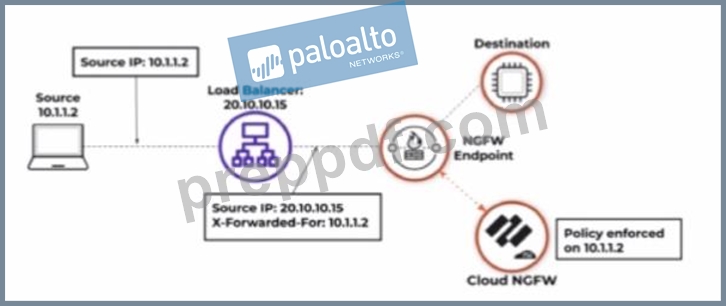
- A. 10.1.1.3
- B. 10.1.1.2
- C. 20.10.10.15
- D. 20.10.10.16
Answer: C
Explanation:
Based on the image and default rulestack settings of the Cloud NGFW for AWS, the source IP address seen in the data filtering logs will be 20.10.10.15, which is the IP address of the load balancer.
Default Rulestack Behavior: By default, the rulestack settings do not inspect or preserve the original client IP (e.g., 10.1.1.2) in the "X-Forwarded-For" header. Instead, the load balancer's IP (20.10.10.15) is recorded as the source IP.
Logging Mechanism: Unless explicitly configured to parse the "X-Forwarded-For" header, the firewall's logs will reflect the IP address of the device directly sending the traffic to the NGFW (the load balancer in this case).
Reference:
Cloud NGFW for AWS Documentation
Data Filtering Logs and Source IP Behavior
NEW QUESTION # 39
Which two pieces of information are needed prior to deploying server certificates from a trusted third-party certificate authority (CA) to GlobalProtect components? (Choose two.)
- A. Subject Alternative Name (SAN)
- B. Passphrase for private key
- C. Encrypted private key and certificate (PKCS12)
- D. Certificate and key files
Answer: C
NEW QUESTION # 40
Which Panorama centralized management feature allows native and third-party integrations to monitor VM-Series NGFW logs and objects?
- A. Log Forwarding profile
- B. Plugin
- C. Device Group
- D. Template
Answer: B
Explanation:
In Panorama centralized management, Plugins enable native and third-party integrations to monitor VM-Series NGFW logs and objects.
How Plugins Enable Integrations in Panorama
Native Integrations - Panorama plugins provide built-in support for cloud environments like AWS, Azure, GCP, as well as VM-Series firewalls.
Third-Party Integrations - Plugins allow Panorama to send logs and security telemetry to third-party systems like SIEMs, SOARs, and IT automation tools.
Log Monitoring & Object Management - Plugins help export logs, monitor firewall events, and manage dynamic firewall configurations in cloud deployments.
Automation and API Support - Plugins extend Panorama's capabilities by integrating with external systems via APIs.
Why Other Options Are Incorrect?
B . Template ❌
Incorrect, because Templates are used for configuring firewall settings like network interfaces, not for log monitoring or third-party integrations.
C . Device Group ❌
Incorrect, because Device Groups manage firewall policies and objects, but do not handle log forwarding or third-party integrations.
D . Log Forwarding Profile ❌
Incorrect, because Log Forwarding Profiles define how logs are sent, but do not provide integration capabilities with third-party tools.
Reference to Firewall Deployment and Security Features:
Firewall Deployment - Panorama uses plugins to integrate VM-Series NGFWs with cloud platforms.
Security Policies - Plugins support policy-based log forwarding and integration with external security tools.
VPN Configurations - Cloud-based VPNs can be managed and monitored using plugins.
Threat Prevention - Plugins enable SIEM integration to monitor threat logs.
WildFire Integration - Some plugins support automated malware analysis and reporting.
Zero Trust Architectures - Supports log-based security analytics for Zero Trust enforcement.
Thus, the correct answer is:
✅ A. Plugin
NEW QUESTION # 41
An administrator has imported a pair of firewalls to Panorama under the same template stack. As a part of the template stack, the administrator wants to create a high availability (HA) template to be shared by the firewalls.
Which dynamic component should the administrator use when setting the Peer HA1 IP address?
- A. Template stack
- B. Template variable
- C. Dynamic Address Group
- D. Address object
Answer: B
Explanation:
When configuring High Availability (HA) settings in Panorama, administrators need to ensure that each firewall in the HA pair has a unique Peer HA1 IP address while using a shared template stack. This is achieved using Template Variables, which allow dynamic configurations per firewall.
Why Template Variable is the Correct Answer?
Ensures Unique HA1 IP Addresses
HA pairs require two separate HA1 IP addresses (one per firewall).
Using template variables, the administrator can assign different values to each firewall without creating separate templates.
Template Variables Provide Flexibility
Instead of hardcoding HA1 IP addresses in the template, variables allow different firewalls to dynamically inherit unique values.
This avoids duplication and ensures configuration scalability when managing multiple firewalls.
Other Answer Choices Analysis
(A) Template Stack - Defines the overall configuration hierarchy but does not provide dynamic IP assignment.
(C) Address Object - Used for security policies and NAT rules, not for HA configurations.
(D) Dynamic Address Group - Primarily used for automated security policies, not HA settings.
Reference and Justification:
Firewall Deployment - HA configurations require unique peer IPs, and template variables provide dynamic assignment.
Panorama - Template variables enhance scalability and simplify HA configurations across multiple devices.
Thus, Template Variable (B) is the correct answer, as it allows dynamic peer HA1 IP assignment while using a shared template stack in Panorama.
NEW QUESTION # 42
With Strata Cloud Manager (SCM), which action will efficiently manage Security policies across multiple cloud providers and on-premises data centers?
- A. Allow each cloud provider's native security tools to handle policy enforcement independently.
- B. Create and manage separate Security policies for each environment to address specific needs.
- C. Use the "Feature Adoption" visibility tab on a weekly basis to make adjustments across the network.
- D. Use snippets and folders to define and enforce uniform Security policies across environments.
Answer: D
NEW QUESTION # 43
Which two tools can be used to configure Cloud NGFWs for AWS? (Choose two.)
- A. Cortex XSIAM
- B. Cloud service provider's management console
- C. Prisma Cloud management console
- D. Panorama
Answer: B
NEW QUESTION # 44
How are content updates downloaded and installed for Cloud NGFWs?
- A. From the Customer Support Portal
- B. Automatically
- C. Through the management console
- D. Through Panorama
Answer: B
NEW QUESTION # 45
What is the most efficient way in Strata Cloud Manager (SCM) to apply a Security policy to all ten firewalls in one data center?
- A. Set the configuration scope to "Global" and create the Security policy.
- B. Create the Security policy at any configuration scope, then clone it to the ten firewalls.
- C. Create the Security policy on each firewall individually.
- D. Create a folder that groups the ten firewalls together, then create the Security policy at that configuration scope.
Answer: D
Explanation:
In Strata Cloud Manager (SCM), the most efficient way to apply a Security policy to multiple firewalls in a single data center is to group the firewalls together into a folder and create the Security policy at that configuration scope.
Grouping Firewalls: By organizing the ten firewalls into a folder, administrators can manage them as a single entity, reducing configuration time and ensuring consistency.
Configuration Scope: SCM allows you to create policies at different scopes, such as Global, Device Group, or Folder level. By applying the policy at the folder scope, it is automatically propagated to all firewalls within the group.
Efficiency: This approach eliminates the need to individually configure each firewall or manually clone policies, which can be time-consuming and error-prone.
Reference:
Strata Cloud Manager Policy Management
Best Practices for Multi-Firewall Management
NEW QUESTION # 46
A company currently uses Prisma Access for its mobile users. A use case is discovered in which mobile users will need to access an internal site, but there is no existing network communication between the mobile users and the internal site.
Which Prisma Access functionality needs to be deployed to enable routing between the mobile users and the internal site?
- A. Interconnect license
- B. Autonomous Digital Experience Manager (ADEM)
- C. Service connection
- D. Security processing node
Answer: C
NEW QUESTION # 47
Which two SSH Proxy decryption profile configurations will reduce network attack surface? (Choose two.)
- A. Allow sessions if resources not available.
- B. Block sessions with unsupported versions.
- C. Allow sessions with unsupported versions.
- D. Block sessions on certificate errors.
Answer: D
NEW QUESTION # 48
Which tool will help refine a security rule by specifying the applications it has viewed in past weeks?
- A. Autonomous Digital Experience Management (ADEM)
- B. Security Lifecycle Review (SLR)
- C. Custom Reporting
- D. Policy Optimizer
Answer: B
NEW QUESTION # 49
When a firewall acts as an application-level gateway (ALG), what does it require in order to establish a connection?
- A. Dynamic IP and Port (DIPP)
- B. Payload
- C. Pinhole
- D. Session Initiation Protocol (SIP)
Answer: C
NEW QUESTION # 50
Which step is necessary to ensure an organization is using the inline cloud analysis features in its Advanced Threat Prevention subscription?
- A. Update or create a new anti-spyware security profile and enable the appropriate local deep -learning models.
- B. Disable anti-spyware to avoid performance impacts and rely solely on external threat intelligence.
- C. Configure Advanced Threat Prevention profiles with default settings and only focus on high-risk traffic to avoid affecting network performance.
- D. Enable SSL decryption in Security policies to inspect and analyze encrypted traffic for threats.
Answer: D
Explanation:
The inline cloud analysis feature in the Advanced Threat Prevention subscription enables real-time threat detection using machine learning (ML) and deep-learning models. However, for it to be effective, the firewall must decrypt encrypted traffic to analyze potential threats hidden within TLS/SSL connections.
Why SSL Decryption is Necessary?
Threat actors often hide malware and exploits in encrypted traffic.
Without SSL decryption, inline cloud analysis cannot inspect encrypted threats.
Decryption allows full visibility into traffic for inline deep-learning threat detection.
Why Other Options Are Incorrect?
A . Configure Advanced Threat Prevention profiles with default settings and only focus on high-risk traffic to avoid affecting network performance. ❌ Incorrect, because default settings may not enable inline cloud analysis, and focusing only on high-risk traffic reduces security effectiveness.
C . Update or create a new anti-spyware security profile and enable the appropriate local deep-learning models. ❌ Incorrect, because Anti-Spyware profiles detect command-and-control (C2) traffic, but inline cloud analysis requires inspecting full packet content, which requires SSL decryption.
D . Disable anti-spyware to avoid performance impacts and rely solely on external threat intelligence. ❌ Incorrect, because disabling anti-spyware would leave the network vulnerable. Inline cloud analysis works in conjunction with threat intelligence and local prevention capabilities.
Reference to Firewall Deployment and Security Features:
Firewall Deployment - Ensures encrypted traffic is inspected for threats.
Security Policies - Requires SSL decryption policies to apply Advanced Threat Prevention.
VPN Configurations - Ensures decryption and inspection apply to VPN traffic.
Threat Prevention - Works alongside Advanced WildFire and inline ML models.
WildFire Integration - Inspects unknown threats in decrypted files.
Zero Trust Architectures - Enforces continuous inspection of all encrypted traffic.
Thus, the correct answer is:
✅ B. Enable SSL decryption in Security policies to inspect and analyze encrypted traffic for threats.
NEW QUESTION # 51
Which action must a firewall administrator take to incorporate custom vulnerability signatures into current Security policies?
- A. Download threat updates.
- B. Download WildFire updates.
- C. Create custom objects.
- D. Create custom policies.
Answer: D
NEW QUESTION # 52
Refer to the exhibit.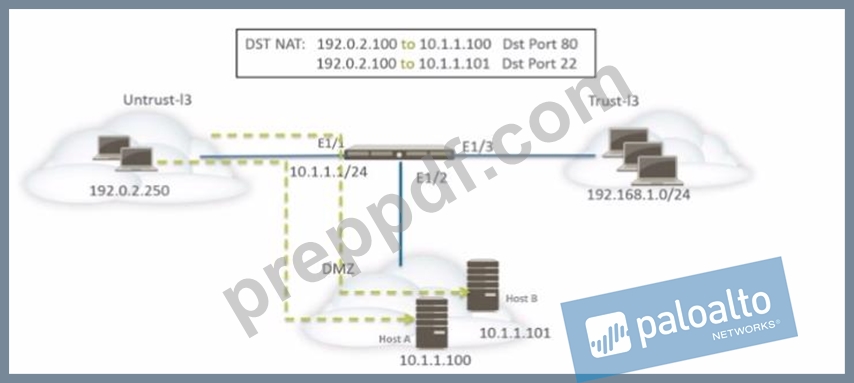
A network administrator is using DNAT to map two servers to one public IP address. Traffic will be directed to a specific server based on the application, where Host A (10.1.1.100) receives HTTP traffic and Host B (10.1.1.101) receives SSH traffic.
Which two sets of Security policy rules will accomplish this configuration? (Choose two.)
- A. Source: Untrust (Any) Destination: Untrust Application(s): web-browsing Action: allow
- B. Source: Untrust (Any) Destination: DMZ Application(s): web-browsing Action: allow
- C. Source: Untrust (Any) Destination: DMZ Application(s): ssh Action: allow
- D. Source: Untrust (Any) Destination: Trust Application(s): web-browsing, ssh Action: allow
Answer: A
NEW QUESTION # 53
Which type of traffic can a firewall use for proper classification and visibility of internet of things (loT) devices?
- A. DHCP
- B. RADIUS
- C. RTP
- D. SSH
Answer: A
Explanation:
To properly classify and gain visibility into Internet of Things (IoT) devices, a firewall can analyze DHCP traffic, as IoT devices frequently use DHCP for network connectivity.
Why DHCP is the Correct Answer?
IoT Devices Often Use DHCP for IP Assignment -
Most IoT devices (smart cameras, sensors, medical devices, industrial controllers) dynamically obtain IP addresses via DHCP.
Firewalls can inspect DHCP requests to identify device types based on DHCP Option 55 (Parameter Request List) and Option 60 (Vendor Class Identifier).
Enhances IoT Security with Granular Policies -
Palo Alto Networks IoT Security uses DHCP data to assign risk scores, enforce access control policies, and detect anomalies.
Does Not Require Deep Packet Inspection -
Unlike RTP, RADIUS, or SSH, which focus on specific protocols for media streaming, authentication, and encryption, DHCP data is lightweight and easily analyzed.
Why Other Options Are Incorrect?
B . RTP (Real-Time Transport Protocol) ❌
Incorrect, because RTP is used for media streaming (VoIP, video conferencing), not device classification.
C . RADIUS (Remote Authentication Dial-In User Service) ❌
Incorrect, because RADIUS is an authentication protocol, not a traffic type used for IoT device classification.
D . SSH (Secure Shell) ❌
Incorrect, because SSH is an encrypted protocol used for remote device access, not identifying IoT devices.
Reference to Firewall Deployment and Security Features:
Firewall Deployment - Firewalls use DHCP fingerprinting for IoT visibility.
Security Policies - DHCP data enables dynamic security policy enforcement for IoT devices.
VPN Configurations - Ensures IoT devices using VPN connections are correctly classified.
Threat Prevention - Detects malicious IoT devices based on DHCP metadata.
WildFire Integration - Prevents IoT devices from being used in botnet attacks.
Zero Trust Architectures - Ensures least-privilege access policies for IoT devices.
NEW QUESTION # 54
Which action must a firewall administrator take to incorporate custom vulnerability signatures into current Security policies?
- A. Download threat updates.
- B. Download WildFire updates.
- C. Create custom objects.
- D. Create custom policies.
Answer: C
Explanation:
To incorporate custom vulnerability signatures into current Security policies, administrators must create custom objects. These objects define the specific signature patterns for vulnerabilities, and they can then be applied to security profiles or policies.
Custom Objects: Allow administrators to define and configure unique vulnerability signatures tailored to the organization's specific needs.
Integration into Security Policies: Once created, these custom objects can be referenced in Security policies to detect and mitigate the specified vulnerabilities effectively.
This approach ensures that custom threats not covered by default threat signatures are adequately addressed, enhancing the firewall's threat prevention capabilities.
Reference:
Custom Vulnerability Signatures in Palo Alto Networks
Threat Prevention Customization
NEW QUESTION # 55
Which two policies in Strata Cloud Manager (SCM) will ensure the personal data of employees remains private while enabling decryption for mobile users in Prisma Access? (Choose two.)
- A. SSL Inbound Inspection
- B. SSH Decryption
- C. SSL Forward Proxy
- D. No Decryption
Answer: C,D
Explanation:
In Strata Cloud Manager (SCM), policies need to balance privacy while ensuring secure decryption for mobile users in Prisma Access. The correct approach involves:
SSL Forward Proxy (C) - Enables decryption of outbound SSL traffic, allowing security inspection while ensuring unauthorized data does not leave the network.
No Decryption (D) - Excludes personal data from being decrypted, ensuring compliance with privacy regulations (e.g., GDPR, HIPAA) and protecting sensitive employee information.
Why These Two Policies?
SSL Forward Proxy (C)
Decrypts outbound SSL traffic from mobile users.
Inspects traffic for malware, data exfiltration, and compliance violations.
Ensures corporate security policies are enforced on user traffic.
No Decryption (D)
Ensures privacy-sensitive traffic (e.g., online banking, healthcare portals) remains untouched.
Exclusions can be defined based on categories, user groups, or destinations.
Helps maintain regulatory compliance while still securing other traffic.
Other Answer Choices Analysis
(A) SSH Decryption - Not relevant in this context, as SSH traffic is typically used for administrative access rather than mobile user web browsing.
(B) SSL Inbound Inspection - Used for inbound traffic to company-hosted servers, not for securing outbound traffic from mobile users.
Reference and Justification:
Firewall Deployment - SSL Forward Proxy enables traffic visibility, No Decryption protects privacy.
Security Policies - Defines what traffic should or should not be decrypted.
Threat Prevention & WildFire - Decryption helps detect hidden threats while excluding sensitive personal data.
Zero Trust Architectures - Ensures least-privilege access while maintaining privacy compliance.
Thus, SSL Forward Proxy (C) and No Decryption (D) are the correct answers, as they balance security and privacy for mobile users in Prisma Access.
NEW QUESTION # 56
Which two tools can be used to configure Cloud NGFWs for AWS? (Choose two.)
- A. Cortex XSIAM
- B. Cloud service provider's management console
- C. Prisma Cloud management console
- D. Panorama
Answer: B,D
Explanation:
Cloud NGFW for AWS is a managed next-generation firewall service provided by Palo Alto Networks, designed to secure AWS environments. It can be configured using two primary tools:
Cloud Service Provider's Management Console (AWS Console) -
AWS users can deploy and manage Cloud NGFW for AWS directly from the AWS Marketplace or AWS Management Console.
The AWS console allows integration with AWS native services, such as VPCs, security groups, and IAM policies.
Panorama -
Panorama provides centralized policy and configuration management for Cloud NGFW instances deployed across AWS.
It enables consistent security policy enforcement, log aggregation, and seamless integration with on-premises and multi-cloud firewalls.
Why Other Options Are Incorrect?
A . Cortex XSIAM ❌
Incorrect, because Cortex XSIAM is an AI-driven security operations platform, not a tool for Cloud NGFW configuration.
It focuses on SOC automation, threat detection, and response rather than firewall policy management.
C . Prisma Cloud Management Console ❌
Incorrect, because Prisma Cloud is designed for cloud security posture management (CSPM) and compliance.
While Prisma Cloud monitors security risks in AWS, it does not configure or manage Cloud NGFW policies.
Reference to Firewall Deployment and Security Features:
Firewall Deployment - Cloud NGFW integrates with AWS network architecture.
Security Policies - Panorama enforces security policies across AWS workloads.
VPN Configurations - Cloud NGFW supports AWS-based VPN traffic inspection.
Threat Prevention - Protects AWS workloads from malware, exploits, and network threats.
WildFire Integration - Detects unknown threats within AWS environments.
Zero Trust Architectures - Secures AWS cloud workloads using Zero Trust principles.
Thus, the correct answers are:
✅ B. Cloud service provider's management console
✅ D. Panorama
NEW QUESTION # 57
Infrastructure performance issues and resource constraints have prompted a firewall administrator to monitor hardware NGFW resource statistics.
Which AlOps feature allows the administrator to review these statistics for each firewall in the environment?
- A. Policy Analyzer
- B. Host information profile (HIP)
- C. Capacity Analyzer
- D. Security Posture Insights
Answer: C
Explanation:
The Capacity Analyzer feature in Palo Alto Networks' AIOps for NGFW (Next-Generation Firewall) provides administrators with insights into hardware resource statistics for each firewall in the environment. It helps identify infrastructure performance issues and resource constraints, such as CPU usage, session capacity, and throughput levels.
Capacity Monitoring: It enables real-time and historical monitoring of resource usage to ensure optimal performance.
Proactive Issue Detection: Administrators can proactively address resource constraints before they impact the network.
Unified Visibility: With AIOps, the Capacity Analyzer aggregates data from all managed firewalls, providing centralized visibility into resource utilization across the environment.
Reference:
Palo Alto Networks AIOps Documentation
Capacity Analyzer Overview
NEW QUESTION # 58
......
Palo Alto Networks Exam 2025 NetSec-Generalist Dumps Updated Questions: https://measureup.preppdf.com/Palo-Alto-Networks/NetSec-Generalist-prepaway-exam-dumps.html