

Microsoft Azure DP-100 Real Exam Questions and Answers FREE Updated on Feb 05, 2026
DP-100 Ultimate Study Guide - PrepPDF
The DP-100 certification is an excellent way for data professionals to demonstrate their expertise in designing and implementing data science solutions on the Azure platform. With the demand for data science skills on the rise, earning the DP-100 certification can open up new career opportunities and help professionals stay competitive in the job market.
NEW QUESTION # 227
You need to define a process for penalty event detection.
Which three actions should you perform in sequence? To answer, move the appropriate actions from the list of actions to the answer area and arrange them in the correct order.
Answer:
Explanation:
NEW QUESTION # 228
You need to use the Python language to build a sampling strategy for the global penalty detection models.
How should you complete the code segment? To answer, select the appropriate options in the answer area.
NOTE: Each correct selection is worth one point.
Answer:
Explanation:
Explanation
Box 1: import pytorch as deeplearninglib
Box 2: ..DistributedSampler(Sampler)..
DistributedSampler(Sampler):
Sampler that restricts data loading to a subset of the dataset.
It is especially useful in conjunction with class:`torch.nn.parallel.DistributedDataParallel`. In such case, each process can pass a DistributedSampler instance as a DataLoader sampler, and load a subset of the original dataset that is exclusive to it.
Scenario: Sampling must guarantee mutual and collective exclusively between local and global segmentation models that share the same features.
Box 3: optimizer = deeplearninglib.train. GradientDescentOptimizer(learning_rate=0.10)
NEW QUESTION # 229
You have an Azure Machine Learning workspace that contains a CPU-based compute cluster and an Azure Kubernetes Services (AKS) inference cluster. You create a tabular dataset containing data that you plan to use to create a classification model.
You need to use the Azure Machine Learning designer to create a web service through which client applications can consume the classification model by submitting new data and getting an immediate prediction as a response.
Which three actions should you perform in sequence? To answer, move the appropriate actions from the list of actions to the answer area and arrange them in the correct order.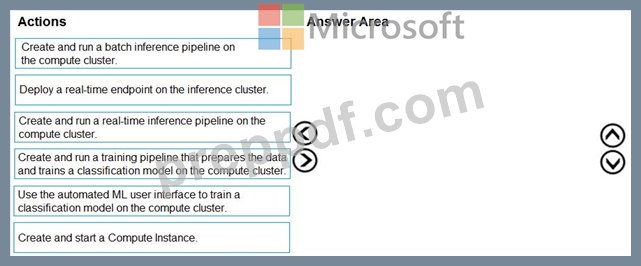
Answer:
Explanation:
1 - Create and start a Compute Instance
2 - Create and run a training pipeline..
3 - Create and run a real-time inference pipeline
Reference:
https://docs.microsoft.com/en-us/learn/modules/create-classification-model-azure-machine-learning-designer/
NEW QUESTION # 230
You create a deep learning model for image recognition on Azure Machine Learning service using GPU- based training.
You must deploy the model to a context that allows for real-time GPU-based inferencing.
You need to configure compute resources for model inferencing.
Which compute type should you use?
- A. Field Programmable Gate Array
- B. Machine Learning Compute
- C. Azure Kubernetes Service
- D. Azure Container Instance
Answer: C
Explanation:
You can use Azure Machine Learning to deploy a GPU-enabled model as a web service. Deploying a model on Azure Kubernetes Service (AKS) is one option. The AKS cluster provides a GPU resource that is used by the model for inference.
Inference, or model scoring, is the phase where the deployed model is used to make predictions. Using GPUs instead of CPUs offers performance advantages on highly parallelizable computation.
ence:
https://docs.microsoft.com/en-us/azure/machine-learning/how-to-deploy-inferencing-gpus
NEW QUESTION # 231
Note: This question is part of a series of questions that present the same scenario. Each question in the series contains a unique solution that might meet the stated goals. Some question sets might have more than one correct solution, while others might not have a correct solution.
After you answer a question in this section, you will NOT be able to return to it. As a result, these questions will not appear in the review screen.
You are creating a model to predict the price of a student's artwork depending on the following variables: the student's length of education, degree type, and art form.
You start by creating a linear regression model.
You need to evaluate the linear regression model.
Solution: Use the following metrics: Accuracy, Precision, Recall, F1 score and AUC.
Does the solution meet the goal?
- A. Yes
- B. No
Answer: B
Explanation:
Those are metrics for evaluating classification models, instead use: Mean Absolute Error, Root Mean Absolute Error, Relative Absolute Error, Relative Squared Error, and the Coefficient of Determination.
References:
https://docs.microsoft.com/en-us/azure/machine-learning/studio-module-reference/evaluate-model
NEW QUESTION # 232
You have a dataset that contains over 150 features. You use the dataset to train a Support Vector Machine (SVM) binary classifier.
You need to use the Permutation Feature Importance module in Azure Machine Learning Studio to compute a set of feature importance scores for the dataset.
In which order should you perform the actions? To answer, move all actions from the list of actions to the answer area and arrange them in the correct order.
Answer:
Explanation:
Explanation:
Step 1: Add a Two-Class Support Vector Machine module to initialize the SVM classifier.
Step 2: Add a dataset to the experiment
Step 3: Add a Split Data module to create training and test dataset.
To generate a set of feature scores requires that you have an already trained model, as well as a test dataset.
Step 4: Add a Permutation Feature Importance module and connect to the trained model and test dataset.
Step 5: Set the Metric for measuring performance property to Classification - Accuracy and then run the experiment.
Reference:
https://docs.microsoft.com/en-us/azure/machine-learning/studio-module-reference/two-class-support-vector- machine
https://docs.microsoft.com/en-us/azure/machine-learning/studio-module-reference/permutation-feature- importance
NEW QUESTION # 233
You create an Azure Machine Learning workspace.
You need to use the shared file system of the workspace to store a clone of a private Git repository.
Which four actions should you perform in sequence? To answer, move the appropriate actions from the list of actions to the answer area and arrange them in the correct order.
Answer:
Explanation:
Explanation:
NEW QUESTION # 234
You create an Azure Machine Learning dataset. You use the Azure Machine Learning designer to transform the dataset by using an Execute Python Script component and custom code.
You must upload the script and associated libraries as a script bundle.
You need to configure the Execute Python Script component.
Which configurations should you use? To answer, select the appropriate options in the answer area.
NOTE Each correct selection is worth one point.
Answer:
Explanation:
Explanation:
NEW QUESTION # 235
Note: This question is part of a series of questions that present the same scenario. Each question in the series contains a unique solution that might meet the stated goals. Some question sets might have more than one correct solution, while others might not have a correct solution.
After you answer a question in this section, you will NOT be able to return to it. As a result, these questions will not appear in the review screen.
You have a Python script named train.py in a local folder named scripts. The script trains a regression model by using scikit-learn. The script includes code to load a training data file which is also located in the scripts folder.
You must run the script as an Azure ML experiment on a compute cluster named aml-compute.
You need to configure the run to ensure that the environment includes the required packages for model training. You have instantiated a variable named aml-compute that references the target compute cluster.
Solution: Run the following code:
Does the solution meet the goal?
- A. Yes
- B. No
Answer: A
Explanation:
The scikit-learn estimator provides a simple way of launching a scikit-learn training job on a compute target. It is implemented through the SKLearn class, which can be used to support single-node CPU training.
Example:
from azureml.train.sklearn import SKLearn
}
estimator = SKLearn(source_directory=project_folder,
compute_target=compute_target,
entry_script='train_iris.py'
)
Reference:
https://docs.microsoft.com/en-us/azure/machine-learning/how-to-train-scikit-learn
NEW QUESTION # 236
You have the following Azure subscriptions and Azure Machine Learning service workspaces:
You need to obtain a reference to the ml-project workspace.
Solution: Run the following Python code:
Does the solution meet the goal?
- A. Yes
- B. No
Answer: B
NEW QUESTION # 237
You are using the Hyperdrive feature in Azure Machine Learning to train a model.
You configure the Hyperdrive experiment by running the following code:
For each of the following statements, select Yes if the statement is true. Otherwise, select No.
NOTE: Each correct selection is worth one point.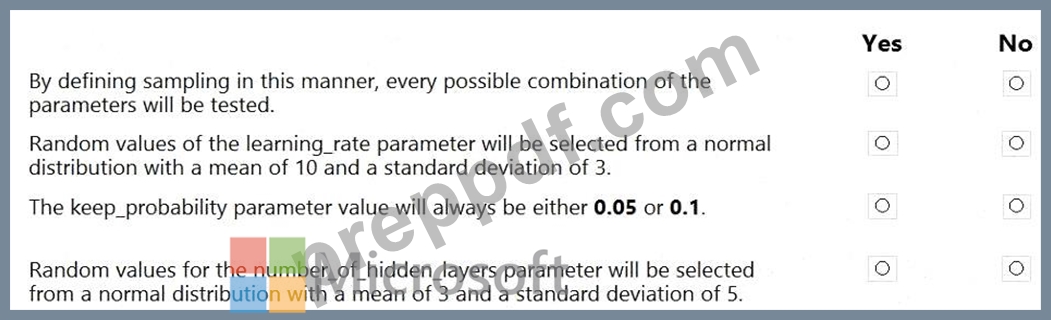
Answer:
Explanation:
Explanation:
Box 1: Yes
In random sampling, hyperparameter values are randomly selected from the defined search space. Random sampling allows the search space to include both discrete and continuous hyperparameters.
Box 2: Yes
learning_rate has a normal distribution with mean value 10 and a standard deviation of 3.
Box 3: No
keep_probability has a uniform distribution with a minimum value of 0.05 and a maximum value of 0.1.
Box 4: No
number_of_hidden_layers takes on one of the values [3, 4, 5].
Reference:
https://docs.microsoft.com/en-us/azure/machine-learning/how-to-tune-hyperparameters
NEW QUESTION # 238
You create an Azure Machine Learning compute target named ComputeOne by using the STANDARD_D1 virtual machine image.
You define a Python variable named was that references the Azure Machine Learning workspace. You run the following Python code: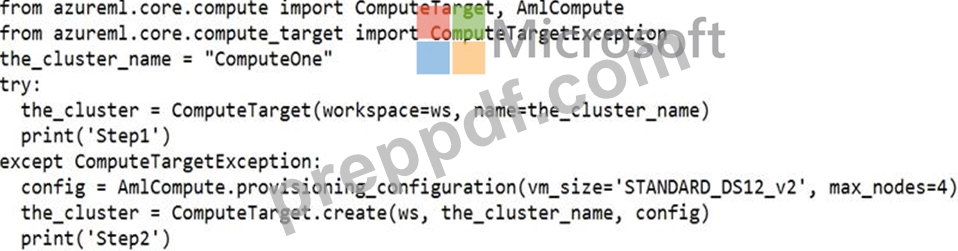
For each of the following statements, select Yes if the statement is true. Otherwise, select No.
NOTE: Each correct selection is worth one point.
Answer:
Explanation:
Reference:
https://docs.microsoft.com/en-us/python/api/azureml-core/azureml.core.compute.computetarget
NEW QUESTION # 239
You configure a Deep Learning Virtual Machine for Windows.
You need to recommend tools and frameworks to perform the following:
Build deep rwur.il network (DNN) models.
Perform interactive data exploration and visualization.
Which tools and frameworks should you recommend? To answer, drag the appropriate tools to the correct tasks. Each tool may be used once, more than once, or not at all. You may need to drag the split bar between panes or scroll to view content.
NOTE: Each correct selection is worth one point.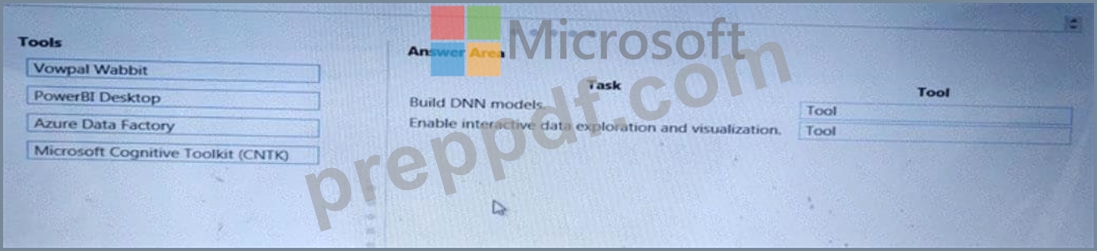
Answer:
Explanation:
NEW QUESTION # 240
You tram and register a model by using the Azure Machine Learning Python SDK v2 in a local workstation. Python 3.7 and Visual Studio Code are instated on the workstation.
When you try to deploy the model into production to a Kubernetes online endpoint you experience an error in the scoring script that causes deployment to fail.
You need to debug the service on the local workstation before deploying the service to production.
Which three actions should you perform m sequence? To answer, move the appropriate actions from the list of actions from the answer area and arrange them in the correct order.
Answer:
Explanation:
1 - install Docker on the worstation.
2 - Run teh begin_create_or_update method of an MLClient class instance with the local parameter set to true.
3 - Debug and modify the scoring script as necessary.
NEW QUESTION # 241
You plan to deliver a hands-on workshop to several students. The workshop will focus on creating data visualizations using Python. Each student will use a device that has internet access.
Student devices are not configured for Python development. Students do not have administrator access to install software on their devices. Azure subscriptions are not available for students.
You need to ensure that students can run Python-based data visualization code.
Which Azure tool should you use?
- A. Azure Machine Learning Service
- B. Anaconda Data Science Platform
- C. Azure Notebooks
- D. Azure BatchAl
Answer: C
Explanation:
Explanation
Explanation/Reference:
References:
https://notebooks.azure.com/
NEW QUESTION # 242
You plan to use automated machine learning to train a regression model. You have data that has features which have missing values, and categorical features with few distinct values.
You need to configure automated machine learning to automatically impute missing values and encode categorical features as part of the training task.
Which parameter and value pair should you use in the AutoMLConfig class?
- A. featurization = 'auto'
- B. task = 'classification'
- C. enable_tf = True
- D. exclude_nan_labels = True
- E. enable_voting_ensemble = True
Answer: A
Explanation:
Explanation
Featurization str or FeaturizationConfig
Values: 'auto' / 'off' / FeaturizationConfig
Indicator for whether featurization step should be done automatically or not, or whether customized featurization should be used.
Column type is automatically detected. Based on the detected column type preprocessing/featurization is done as follows:
Categorical: Target encoding, one hot encoding, drop high cardinality categories, impute missing values.
Numeric: Impute missing values, cluster distance, weight of evidence.
DateTime: Several features such as day, seconds, minutes, hours etc.
Text: Bag of words, pre-trained Word embedding, text target encoding.
Reference:
https://docs.microsoft.com/en-us/python/api/azureml-train-automl-client/azureml.train.automl.automlconfig.auto
NEW QUESTION # 243
Note: This question is part of a series of questions that present the same scenario. Each question in the series contains a unique solution that might meet the stated goals. Some question sets might have more than one correct solution, while others might not have a correct solution.
After you answer a question in this section, you will NOT be able to return to it. As a result, these questions will not appear in the review screen.
You have a Python script named train.py in a local folder named scripts. The script trains a regression model by using scikit-learn. The script includes code to load a training data file which is also located in the scripts folder.
You must run the script as an Azure ML experiment on a compute cluster named aml-compute.
You need to configure the run to ensure that the environment includes the required packages for model training. You have instantiated a variable named aml-compute that references the target compute cluster.
Solution: Run the following code:
Does the solution meet the goal?
- A. Yes
- B. No
Answer: B
Explanation:
The scikit-learn estimator provides a simple way of launching a scikit-learn training job on a compute target.
It is implemented through the SKLearn class, which can be used to support single-node CPU training.
Example:
from azureml.train.sklearn import SKLearn
}
estimator = SKLearn(source_directory=project_folder,
compute_target=compute_target,
entry_script='train_iris.py'
)
Reference:
https://docs.microsoft.com/en-us/azure/machine-learning/how-to-train-scikit-learn
NEW QUESTION # 244
Your team is building a data engineering and data science development environment.
The environment must support the following requirements:
* support Python and Scala
* compose data storage, movement, and processing services into automated data pipelines
* the same tool should be used for the orchestration of both data engineering and data science
* support workload isolation and interactive workloads
* enable scaling across a cluster of machines
You need to create the environment.
What should you do?
- A. Build the environment in Azure Databricks and use Azure Container Instances for orchestration.
- B. Build the environment in Azure Databricks and use Azure Data Factory for orchestration.
- C. Build the environment in Apache Spark for HDInsight and use Azure Container Instances for orchestration.
- D. Build the environment in Apache Hive for HDInsight and use Azure Data Factory for orchestration.
Answer: B
Explanation:
In Azure Databricks, we can create two different types of clusters.
* Standard, these are the default clusters and can be used with Python, R, Scala and SQL
* High-concurrency
Azure Databricks is fully integrated with Azure Data Factory.
NEW QUESTION # 245
You are building a regression model for estimating the number of calls during an event.
You need to determine whether the feature values achieve the conditions to build a Poisson regression model.
Which two conditions must the feature set contain? Each correct answer presents part of the solution.
NOTE: Each correct selection is worth one point.
- A. The label data must be non-discrete.
- B. The label data must be a positive value.
- C. The label data can be positive or negative.
- D. The label data must be a negative value.
- E. The label data must be whole numbers.
Answer: B,E
Explanation:
Poisson regression is intended for use in regression models that are used to predict numeric values, typically counts. Therefore, you should use this module to create your regression model only if the values you are trying to predict fit the following conditions:
* The response variable has a Poisson distribution.
* Counts cannot be negative. The method will fail outright if you attempt to use it with negative labels.
* A Poisson distribution is a discrete distribution; therefore, it is not meaningful to use this method with non- whole numbers.
Reference:
https://docs.microsoft.com/en-us/azure/machine-learning/studio-module-reference/poisson-regression
NEW QUESTION # 246
You are using C-Support Vector classification to do a multi-class classification with an unbalanced training dataset. The C-Support Vector classification using Python code shown below:
You need to evaluate the C-Support Vector classification code.
Which evaluation statement should you use? To answer, select the appropriate options in the answer area.
NOTE: Each correct selection is worth one point.
Answer:
Explanation:
Reference:
https://scikit-learn.org/stable/modules/generated/sklearn.svm.SVC.html
NEW QUESTION # 247
You are building a binary classification model by using a supplied training set.
The training set is imbalanced between two classes.
You need to resolve the data imbalance.
What are three possible ways to achieve this goal? Each correct answer presents a complete solution NOTE:
Each correct selection is worth one point.
- A. Penalize the classification
- B. Generate synthetic samples in the minority class.
- C. Normalize the training feature set.
- D. Resample the data set using under sampling or oversampling
- E. Use accuracy as the evaluation metric of the model.
Answer: A,D,E
Explanation:
Explanation
References:
https://machinelearningmastery.com/tactics-to-combat-imbalanced-classes-in-your-machine-learning-dataset/
NEW QUESTION # 248
You are evaluating a completed binary classification machine learning model.
You need to use the precision as the valuation metric.
Which visualization should you use?
- A. coefficient of determination
- B. Gradient descent
- C. box plot
- D. Binary classification confusion matrix
Answer: D
Explanation:
Explanation
References:
https://machinelearningknowledge.ai/confusion-matrix-and-performance-metrics-machine-learning/
NEW QUESTION # 249
You have a Python data frame named salesData in the following format:
The data frame must be unpivoted to a long data format as follows: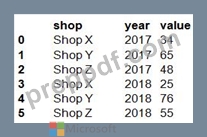
You need to use the pandas.melt() function in Python to perform the transformation.
How should you complete the code segment? To answer, select the appropriate options in the answer area.
NOTE: Each correct selection is worth one point.
Answer:
Explanation:
Explanation:
Box 1: dataFrame
Syntax: pandas.melt(frame, id_vars=None, value_vars=None, var_name=None, value_name='value', col_level=None)[source] Where frame is a DataFrame Box 2: shop Paramter id_vars id_vars : tuple, list, or ndarray, optional Column(s) to use as identifier variables.
Box 3: ['2017','2018']
value_vars : tuple, list, or ndarray, optional
Column(s) to unpivot. If not specified, uses all columns that are not set as id_vars.
Example:
df = pd.DataFrame({'A': {0: 'a', 1: 'b', 2: 'c'},
... 'B': {0: 1, 1: 3, 2: 5},
... 'C': {0: 2, 1: 4, 2: 6}})
pd.melt(df, id_vars=['A'], value_vars=['B', 'C'])
A variable value
0 a B 1
1 b B 3
2 c B 5
3 a C 2
4 b C 4
5 c C 6
References:
https://pandas.pydata.org/pandas-docs/stable/reference/api/pandas.melt.html
NEW QUESTION # 250
You create an Azure Machine Learning workspace.
You must use the Python SDK v2 to implement an experiment from a Jupyter notebook in the workspace. The experiment must log string metrics. You need to implement the method to log the string metrics. Which method should you use?
- A. mlflow.log text()
- B. mlflow.log_artifact()
- C. mlflowlog_metrk()
- D. mlflow.log.dict()
Answer: A
NEW QUESTION # 251
You are tuning a hyperparameter for an algorithm. The following table shows a data set with different hyperparameter, training error, and validation errors.
Use the drop-down menus to select the answer choice that answers each question based on the information presented in the graphic.
Answer:
Explanation:
).
Reference:
https://medium.com/comet-ml/organizing-machine-learning-projects-project-management-guidelines-2d2b85651bbd
NEW QUESTION # 252
......
Microsoft DP-100 certification exam covers a wide range of topics related to data science and machine learning. It requires candidates to have a deep understanding of Azure data services, including Azure Machine Learning, Azure Stream Analytics, and Azure Data Factory. DP-100 exam also tests candidates' knowledge of statistical analysis, data visualization, and data exploration techniques.
Ultimate Guide to Prepare DP-100 Certification Exam for Microsoft Azure: https://measureup.preppdf.com/Microsoft/DP-100-prepaway-exam-dumps.html