

[Mar 28, 2026] PrepPDF DP-300 dumps & Microsoft Azure sure practice dumps
Microsoft DP-300 Actual Questions and Braindumps
Best Self-Revision Materials for DP-300 Exam
Every aspiring candidate who wants to become a proficient Azure Database Administer Associate should know the significance of books for DP-300 preparation. Admittedly, books are handy guides to gather new information. Thus, here are some notable resources for reading from Amazon that candidates should follow for preparing DP-300 exam:
- Inside Out: SQL Server Administration 2017
Get this book by William Assaf and others if you are looking for some viable tips and suggestions to produce success in DP-300 exam with time-saving solutions. All the slightest details about Azure SQL Server are perfectly put together in this book so you will have all that it takes to master the final test.
- Professional Administration of Azure SQL Database
Penned-down by Ahmad Osama, this manual explains viable ways to explore and administer the Azure SQL Server database. It includes result-driven 40-practical activities to reinforce the learning for the upcoming DP-300 test. So, if you want to excel in the official testing, such a book is good to go.
- How I Passed DP-300: Administrating Relational Databases on Microsoft Azure DP-300 Exam
A class product from the house of Empirical Matt Publications, this book is here to teach candidates smart methods to pass DP-300. It covers the related topics thoroughly and helps aspirants prepare well in advance before sitting for their exams.
- Step by Step Developer: Microsoft Azure SQL Database
This is the best hands-on exam guide by Leonard G. Lobel that anyone can take on board while getting ready for the Microsoft DP-300 evaluation. The step-by-step guide and coding exercises are here to turn you into an Azure SQL Server maven.
Get information about the salary of Administering Relational Databases on Microsoft Azure Professional
- England: 74336 Pound
- Europe: 82146 Euro
- India: 7281940 INR
- United States: 97,281 USD
To become certified in Microsoft DP-300, candidates must pass the certification exam. DP-300 exam consists of multiple-choice questions and performance-based scenarios. Candidates are required to demonstrate their ability to perform tasks related to managing and administering databases on Microsoft Azure. DP-300 exam is available in multiple languages and can be taken online or in-person at a testing center.
NEW QUESTION # 95
You have an Azure subscription that contains an Azure SQL database named SQLDb1. SQLDb1 contains a table named Table1.
You plan to deploy an Azure web app named webapp1 that will export rows in Table1 that have changed.
You need to ensure that webapp1 can identity the changes to Table'. The solution must meet the following requirements:
* Minimize compute times.
* Minimize storage.
Which three actions should you perform in sequence? To answer. move the appropriate actions from the list of actions to the answer area and arrange them in the correct order.
Answer:
Explanation: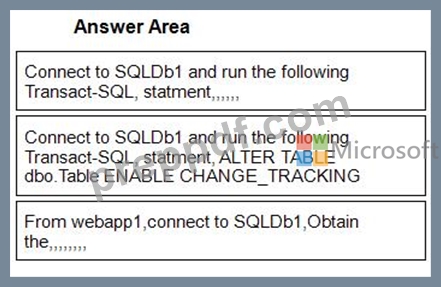
1 - Connect to SQLDb1 and run the following Transact-SQL, statment,,,,,,
2 - Connect to SQLDb1 and run the following Transact-SQL, statment, ALTER TABLE dbo.Table ENABLE CHANGE_TRACKING
3 - From webapp1,connect to SQLDb1,Obtain the,,,,,,,,
NEW QUESTION # 96
You have SQL Server on an Azure virtual machine.
You need to add a 4-TB volume that meets the following requirements:
Maximizes IOPs
Uses premium solid state drives (SSDs)
What should you do?
- A. Attach two mirrored 4-TB SSDs.
- B. Attach a single 4-TB SSD.
- C. Attach a stripe set that contains four 1-TB SSDs.
- D. Attach a RAID-5 array that contains five 1-TB SSDs.
Answer: C
Explanation:
Reference:
https://docs.microsoft.com/en-us/azure/azure-sql/virtual-machines/windows/storage-configuration?tabs=windows2016
NEW QUESTION # 97
You need to implement statistics maintenance for SalesSQLDb1. The solution must meet the technical requirements.
Which four actions should you perform in sequence? To answer, move the appropriate actions from the list of actions to the answer area and arrange them in the correct order.
Answer:
Explanation:
1 - Create Azure automation account
2 - Import SQLServer module
3 - Create a runbook that runs a PowerShell script.
4 - Create and configure a schedule.
Reference:
https://techcommunity.microsoft.com/t5/azure-database-support-blog/automating-azure-sql-db-index-and-statistics-maintenance-using/ba-p/368974
NEW QUESTION # 98
You have SQL Server on an Azure virtual machine that contains a database named DB1. DB1 contains a table named CustomerPII.
You need to record whenever users query the CustomerPII table.
Which two options should you enable? Each correct answer presents part of the solution.
NOTE: Each correct selection is worth one point.
- A. server audit specification
- B. a server principal
- C. SQL Server audit
- D. database audit specification
Answer: C,D
Explanation:
Auditing an instance of SQL Server or a SQL Server database involves tracking and logging events that occur on the system. The SQL Server Audit object collects a single instance of server-level or database-level actions and groups of actions to monitor. The audit is at the SQL Server instance level. You can have multiple audits per SQL Server instance. The Database- Level Audit Specification object belongs to an audit. You can create one database audit specification per SQL Server database per audit.
Reference:
https://docs.microsoft.com/en-us/sql/relational-databases/security/auditing/create-a-server-audit-and-database-audit-specification
NEW QUESTION # 99
You have an Azure SQL database named DB1. DB1 has a table named Table1 that contains the following columns.
You plan to enable Always Encrypted for Table1.
Which two columns support encryption? Each correct answer presents a complete solution.
NOTE: Each correct selection is worth one point
- A. Column1
- B. Column5
- C. Column4
- D. Column3
- E. Column2
Answer: A,C
NEW QUESTION # 100
You have an Azure subscription that is linked to an Azure AD tenant named contoso.com. The subscription contains an Azure SQL database named SQL 1 and an Azure web named app1. App1 has the managed identity feature enabled.
You need to create a new database user for app1.
How should you complete the Transact-SQL statement? To answer, select the appropriate options in the answer are a.
NOTE: Each correct selection is worth one point.
Answer:
Explanation:
NEW QUESTION # 101
Hotspot Question
You configure version control for an Azure Data Factory instance as shown in the following exhibit.
Use the drop-down menus to select the answer choice that completes each statement based on the information presented in the graphic.
NOTE: Each correct selection is worth one point.
Answer:
Explanation:
Explanation:
Box 1: adf_publish
By default, data factory generates the Resource Manager templates of the published factory and saves them into a branch called adf_publish. To configure a custom publish branch, add a publish_config.json file to the root folder in the collaboration branch. When publishing, ADF reads this file, looks for the field publishBranch, and saves all Resource Manager templates to the specified location. If the branch doesn't exist, data factory will automatically create it. And example of what this file looks like is below:
{
"publishBranch": "factory/adf_publish"
}
Box 2: /dwh_barchlet/ adf_publish/contososales
RepositoryName: Your Azure Repos code repository name. Azure Repos projects contain Git repositories to manage your source code as your project grows. You can create a new repository or use an existing repository that's already in your project.
Reference:
https://docs.microsoft.com/en-us/azure/data-factory/source-control
NEW QUESTION # 102
Case Study 1 - Litware, Inc
Overview
Litware, Inc. is a renewable energy company that has a main office in Boston. The main office hosts a sales department and the primary datacenter for the company.
Physical Locations
Existing Environment
Litware has a manufacturing office and a research office is separate locations near Boston. Each office has its own datacenter and internet connection.
The manufacturing and research datacenters connect to the primary datacenter by using a VPN.
Network Environment
The primary datacenter has an ExpressRoute connection that uses both Microsoft peering and private peering. The private peering connects to an Azure virtual network named HubVNet.
Identity Environment
Litware has a hybrid Azure Active Directory (Azure AD) deployment that uses a domain named litwareinc.com. All Azure subscriptions are associated to the litwareinc.com Azure AD tenant.
Database Environment
The sales department has the following database workload:
An on-premises named SERVER1 hosts an instance of Microsoft SQL Server 2012 and two 1- TB databases.
A logical server named SalesSrv01A contains a geo-replicated Azure SQL database named SalesSQLDb1. SalesSQLDb1 is in an elastic pool named SalesSQLDb1Pool. SalesSQLDb1 uses database firewall rules and contained database users.
An application named SalesSQLDb1App1 uses SalesSQLDb1.
The manufacturing office contains two on-premises SQL Server 2016 servers named SERVER2 and SERVER3. The servers are nodes in the same Always On availability group. The availability group contains a database named ManufacturingSQLDb1 Database administrators have two Azure virtual machines in HubVnet named VM1 and VM2 that run Windows Server 2019 and are used to manage all the Azure databases.
Licensing Agreement
Litware is a Microsoft Volume Licensing customer that has License Mobility through Software Assurance.
Current Problems
SalesSQLDb1 experiences performance issues that are likely due to out-of-date statistics and frequent blocking queries.
Requirements
Planned Changes
Litware plans to implement the following changes:
Implement 30 new databases in Azure, which will be used by time-sensitive manufacturing apps that have varying usage patterns. Each database will be approximately 20 GB.
Create a new Azure SQL database named ResearchDB1 on a logical server named ResearchSrv01. ResearchDB1 will contain Personally Identifiable Information (PII) data.
Develop an app named ResearchApp1 that will be used by the research department to populate and access ResearchDB1.
Migrate ManufacturingSQLDb1 to the Azure virtual machine platform.
Migrate the SERVER1 databases to the Azure SQL Database platform.
Technical Requirements
Litware identifies the following technical requirements:
Maintenance tasks must be automated.
The 30 new databases must scale automatically.
The use of an on-premises infrastructure must be minimized.
Azure Hybrid Use Benefits must be leveraged for Azure SQL Database deployments.
All SQL Server and Azure SQL Database metrics related to CPU and storage usage and limits must be analyzed by using Azure built-in functionality.
Security and Compliance Requirements
Litware identifies the following security and compliance requirements:
Store encryption keys in Azure Key Vault.
Retain backups of the PII data for two months.
Encrypt the PII data at rest, in transit, and in use.
Use the principle of least privilege whenever possible.
Authenticate database users by using Active Directory credentials.
Protect Azure SQL Database instances by using database-level firewall rules.
Ensure that all databases hosted in Azure are accessible from VM1 and VM2 without relying on public endpoints.
Business Requirements
Litware identifies the following business requirements:
Meet an SLA of 99.99% availability for all Azure deployments.
Minimize downtime during the migration of the SERVER1 databases.
Use the Azure Hybrid Use Benefits when migrating workloads to Azure.
Once all requirements are met, minimize costs whenever possible.
Hotspot Question
You are planning the migration of the SERVER1 databases. The solution must meet the business requirements.
What should you include in the migration plan? To answer, select the appropriate options in the answer area.
NOTE: Each correct selection is worth one point.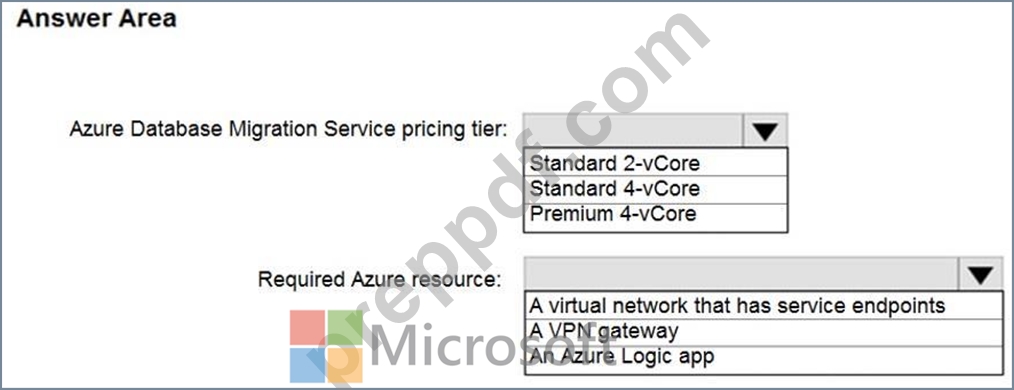
Answer:
Explanation:
Explanation:
Box 1: Premium 4-VCore
Scenario:
An on-premises named SERVER1 hosts an instance of Microsoft SQL Server 2012 and two 1-TB databases.
Migrate the SERVER1 databases to the Azure SQL Database platform.
Minimize downtime during the migration of the SERVER1 databases.
Premimum 4-vCore is for large or business critical workloads. It supports online migrations, offline migrations, and faster migration speeds.
Incorrect Answers:
The Standard pricing tier suits most small- to medium- business workloads, but it supports offline migration only.
Box 2: A virtual network that has service endpoints
Scenario: The primary datacenter has an ExpressRoute connection that uses both Microsoft peering and private peering.
You need to create a Microsoft Azure Virtual Network for the Azure Database Migration Service by using the Azure Resource Manager deployment model, which provides site-to-site connectivity to your on-premises source servers by using either ExpressRoute or VPN.
Note: During virtual network setup, if you use ExpressRoute with network peering to Microsoft, add the following service endpoints to the subnet in which the service will be provisioned:
Target database endpoint (for example, SQL endpoint, Cosmos DB endpoint, and so on) Storage endpoint Service bus endpoint This configuration is necessary because Azure Database Migration Service lacks internet connectivity.
Reference:
https://azure.microsoft.com/pricing/details/database-migration/
https://docs.microsoft.com/en-us/azure/dms/tutorial-sql-server-azure-sql-online
NEW QUESTION # 103
You have an Azure Data Factory pipeline that is triggered hourly.
The pipeline has had 100% success for the past seven days.
The pipeline execution fails, and two retries that occur 15 minutes apart also fail. The third failure returns the following error.
What is a possible cause of the error?
- A. The pipeline was triggered too early.
- B. From 06:00 to 07:00 on January 10, 2021, there was no data in wwi/BIKES/CARBON.
- C. The parameter used to generate year=2021/month=01/day=10/hour=06 was incorrect.
- D. From 06:00 to 07:00 on January 10, 2021, the file format of data in wwi/BIKES/CARBON was incorrect.
Answer: C
NEW QUESTION # 104
You have an Azure SQL managed instance.
You need to configure the SQL Server Agent service to email job notifications.
Which statement should you execute?
- A. EXECUTE msdb.dbo.sysmail_add_profile_sp @profile_name = 'application_dbmail_profile';
- B. EXECUTE msdb.dbo.sysmail_add_profile_sp @profile_name = 'sysadmin_dbmail_profile';
- C. EXECUTE msdb.dbo.sysmail_add_profile_sp @profile_name =
'AzureManagedInstance_dbmail_profile'; - D. EXECUTE msdb.dbo.sysmail_add_profile_sp @profile_name = 'sys_dbmail_profile';
Answer: C
Explanation:
To send e-mail using SQL Agent jobs in SQL Managed Instance, there should be a profile that must be called AzureManagedInstance_dbmail_profile. Otherwise, SQL Managed Instance will be unable to send emails via SQL Agent.
https://learn.microsoft.com/en-us/azure/azure-sql/managed-instance/job-automation-managed-instance?view=azuresql#sql-agent-job-notifications
NEW QUESTION # 105
You have two Azure virtual machines named VM1 and VM2 that run Windows Server 2019. VM1 and VM2 each host a default Microsoft SQL Server 2019 instance. VM1 contains a database named DB1 that is backed up to a file named D:\DB1.bak.
You plan to deploy an Always On availability group that will have the following configurations:
VM1 will host the primary replica of DB1.
VM2 will host a secondary replica of DB1.
You need to prepare the secondary database on VM2 for the availability group.
How should you complete the Transact-SQL statement? To answer, select the appropriate options in the answer area.
Answer:
Explanation:
Reference:
https://docs.microsoft.com/en-us/sql/database-engine/availability-groups/windows/manually-prepare-a-secondary-database-for-an-availability-group-sql-server?view=sql-server-ver15
NEW QUESTION # 106
You need to recommend a configuration for ManufacturingSQLDb1 after the migration to Azure. The solution must meet the business requirements.
What should you include in the recommendation? To answer, select the appropriate options in the answer area.
NOTE: Each correct selection is worth one point.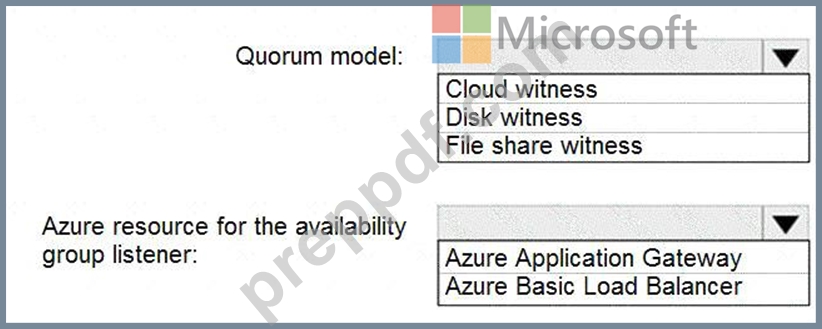
Answer:
Explanation:
Explanation
Scenario: Business Requirements
Litware identifies business requirements include: meet an SLA of 99.99% availability for all Azure deployments.
Box 1: Cloud witness
If you have a Failover Cluster deployment, where all nodes can reach the internet (by extension of Azure), it is recommended that you configure a Cloud Witness as your quorum witness resource.
Box 2: Azure Basic Load Balancer
Microsoft guarantees that a Load Balanced Endpoint using Azure Standard Load Balancer, serving two or more Healthy Virtual Machine Instances, will be available 99.99% of the time.
Note: There are two main options for setting up your listener: external (public) or internal. The external (public) listener uses an internet facing load balancer and is associated with a public Virtual IP (VIP) that is accessible over the internet. An internal listener uses an internal load balancer and only supports clients within the same Virtual Network.
Reference:
https://technet.microsoft.com/windows-server-docs/failover-clustering/deploy-cloud-witness
https://azure.microsoft.com/en-us/support/legal/sla/load-balancer/v1_0/
NEW QUESTION # 107
You have an Azure virtual machine named VM1 on a virtual network named VNet1. Outbound traffic from VM1 to the internet is blocked.
You have an Azure SQL database named SqlDb1 on a logical server named SqlSrv1.
You need to implement connectivity between VM1 and SqlDb1 to meet the following requirements:
Ensure that VM1 cannot connect to any Azure SQL Server other than SqlSrv1.
Restrict network connectivity to SqlSrv1.
What should you create on VNet1?
- A. a service endpoint
- B. a private link
- C. a VPN gateway
- D. an ExpressRoute gateway
Answer: B
Explanation:
Azure Private Link enables you to access Azure PaaS Services (for example, Azure Storage and SQL Database) and Azure hosted customer-owned/partner services over a private endpoint in your virtual network.
Traffic between your virtual network and the service travels the Microsoft backbone network. Exposing your service to the public internet is no longer necessary.
Reference:
https://docs.microsoft.com/en-us/azure/private-link/private-link-overview
NEW QUESTION # 108
You need to design an analytical storage solution for the transactional dat a. The solution must meet the sales transaction dataset requirements.
What should you include in the solution? To answer, select the appropriate options in the answer area.
NOTE: Each correct selection is worth one point.
Answer:
Explanation:
Reference:
https://rajanieshkaushikk.com/2020/09/09/how-to-choose-right-data-distribution-strategy-for-azure-synapse/
NEW QUESTION # 109
You have an Azure subscription.
You plan to migrate 10 on-premises Microsoft SQL Server instances to Azure.
You need to ensure that the migrated environment can be managed by using multiserver administration and supports master/target (MSX/TSX) jobs. The solution must minimize administrative effort.
Which SQL deployment options should you select as the master server (MSX) and the target server (TSX)? To answer, select the appropriate options in the answer area.
NOTE: Each correct selection is worth one point.
Answer:
Explanation:
Explanation:
NEW QUESTION # 110
Drag and Drop Question
You have an Azure subscription that contains an Azure SQL database named SQLDb1. SQLDb1 contains a table named Table1.
You plan to deploy an Azure web app named webapp1 that will export the rows in Table1 that have changed.
You need to ensure that webapp1 can identify the changes to Table1. The solution must meet the following requirements:
- Minimize compute times.
- Minimize storage.
Which three actions should you perform in sequence? To answer, move the appropriate actions from the list of actions to the answer area and arrange them in the correct order.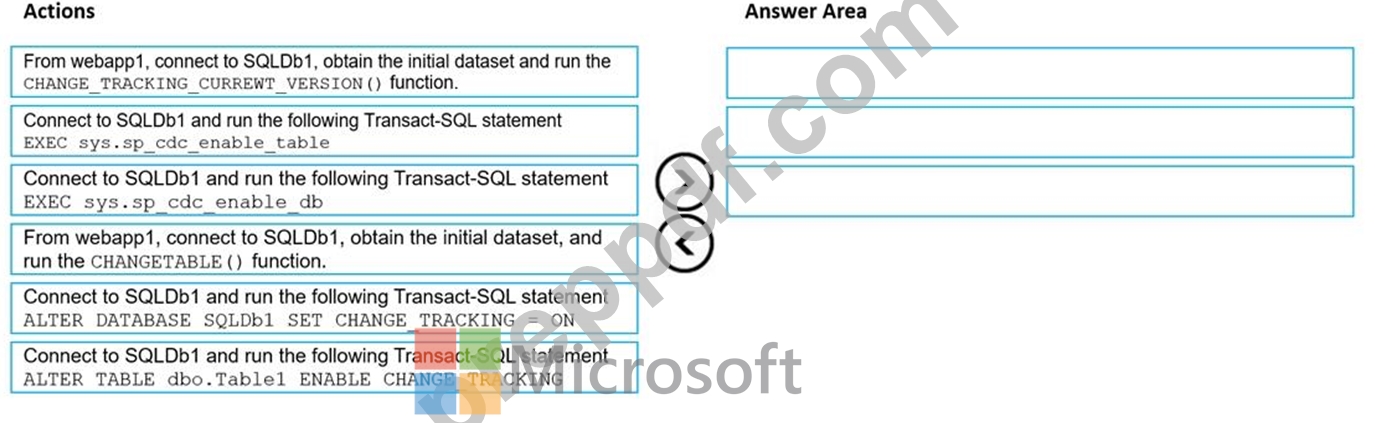
Answer:
Explanation:
Explanation:
https://learn.microsoft.com/en-us/sql/relational-databases/track-changes/about-change-tracking-sql-server?view=sql-server-ver16
To track changes, change tracking must first be enabled for the database and then enabled for the tables that you want to track within that database. The table definition does not have to be changed in any way, and no triggers are created.
NEW QUESTION # 111
You have an Azure Databricks resource.
You need to log actions that relate to changes in compute for the Databricks resource.
Which Databricks services should you log?
- A. clusters
- B. workspace
- C. DBFS
- D. jobs
- E. SSH
Answer: B
Explanation:
Cloud Provider Infrastructure Logs.
Databricks logging allows security and admin teams to demonstrate conformance to data governance standards within or from a Databricks workspace. Customers, especially in the regulated industries, also need records on activities like:
User access control to cloud data storage
Cloud Identity and Access Management roles
User access to cloud network and compute
Azure Databricks offers three distinct workloads on several VM Instances tailored for your data analytics workflow-the Jobs Compute and Jobs Light Compute workloads make it easy for data engineers to build and execute jobs, and the All-Purpose Compute workload makes it easy for data scientists to explore, visualize, manipulate, and share data and insights interactively.
Reference:
https://databricks.com/blog/2020/03/25/trust-but-verify-with-databricks.html
NEW QUESTION # 112
Case Study 1 - Litware, Inc
Overview
Litware, Inc. is a renewable energy company that has a main office in Boston. The main office hosts a sales department and the primary datacenter for the company.
Physical Locations
Existing Environment
Litware has a manufacturing office and a research office is separate locations near Boston. Each office has its own datacenter and internet connection.
The manufacturing and research datacenters connect to the primary datacenter by using a VPN.
Network Environment
The primary datacenter has an ExpressRoute connection that uses both Microsoft peering and private peering. The private peering connects to an Azure virtual network named HubVNet.
Identity Environment
Litware has a hybrid Azure Active Directory (Azure AD) deployment that uses a domain named litwareinc.com. All Azure subscriptions are associated to the litwareinc.com Azure AD tenant.
Database Environment
The sales department has the following database workload:
An on-premises named SERVER1 hosts an instance of Microsoft SQL Server 2012 and two 1- TB databases.
A logical server named SalesSrv01A contains a geo-replicated Azure SQL database named SalesSQLDb1. SalesSQLDb1 is in an elastic pool named SalesSQLDb1Pool. SalesSQLDb1 uses database firewall rules and contained database users.
An application named SalesSQLDb1App1 uses SalesSQLDb1.
The manufacturing office contains two on-premises SQL Server 2016 servers named SERVER2 and SERVER3. The servers are nodes in the same Always On availability group. The availability group contains a database named ManufacturingSQLDb1 Database administrators have two Azure virtual machines in HubVnet named VM1 and VM2 that run Windows Server 2019 and are used to manage all the Azure databases.
Licensing Agreement
Litware is a Microsoft Volume Licensing customer that has License Mobility through Software Assurance.
Current Problems
SalesSQLDb1 experiences performance issues that are likely due to out-of-date statistics and frequent blocking queries.
Requirements
Planned Changes
Litware plans to implement the following changes:
Implement 30 new databases in Azure, which will be used by time-sensitive manufacturing apps that have varying usage patterns. Each database will be approximately 20 GB.
Create a new Azure SQL database named ResearchDB1 on a logical server named ResearchSrv01. ResearchDB1 will contain Personally Identifiable Information (PII) data.
Develop an app named ResearchApp1 that will be used by the research department to populate and access ResearchDB1.
Migrate ManufacturingSQLDb1 to the Azure virtual machine platform.
Migrate the SERVER1 databases to the Azure SQL Database platform.
Technical Requirements
Litware identifies the following technical requirements:
Maintenance tasks must be automated.
The 30 new databases must scale automatically.
The use of an on-premises infrastructure must be minimized.
Azure Hybrid Use Benefits must be leveraged for Azure SQL Database deployments.
All SQL Server and Azure SQL Database metrics related to CPU and storage usage and limits must be analyzed by using Azure built-in functionality.
Security and Compliance Requirements
Litware identifies the following security and compliance requirements:
Store encryption keys in Azure Key Vault.
Retain backups of the PII data for two months.
Encrypt the PII data at rest, in transit, and in use.
Use the principle of least privilege whenever possible.
Authenticate database users by using Active Directory credentials.
Protect Azure SQL Database instances by using database-level firewall rules.
Ensure that all databases hosted in Azure are accessible from VM1 and VM2 without relying on public endpoints.
Business Requirements
Litware identifies the following business requirements:
Meet an SLA of 99.99% availability for all Azure deployments.
Minimize downtime during the migration of the SERVER1 databases.
Use the Azure Hybrid Use Benefits when migrating workloads to Azure.
Once all requirements are met, minimize costs whenever possible.
Drag and Drop Question
You need to configure user authentication for the SERVER1 databases. The solution must meet the security and compliance requirements.
Which three actions should you perform in sequence? To answer, move the appropriate actions from the list of actions to the answer area and arrange them in the correct order.
Answer:
Explanation:
Explanation:
Box 1: Register ResearchApp1 to Azure AD.
Box 2: Create an Azure Key Vault instance and configure an access policy.
Need to configure the key vault with an access policy to enable ResearchApp1 retrieval of the keys.
Box 3: Run the Always Encrypt wizard.
Run the Always Encrypt wizard to encrypt the columns and store the encryption keys in the vault.
Reference:
https://docs.microsoft.com/en-us/azure/azure-sql/database/always-encrypted-azure-key-vault-configure?tabs=azure-powershell
NEW QUESTION # 113
......
Latest DP-300 Pass Guaranteed Exam Dumps with Accurate & Updated Questions: https://measureup.preppdf.com/Microsoft/DP-300-prepaway-exam-dumps.html