

300-620 Actual Questions Answers PDF 100% Cover Real Exam Questions
300-620 Exam questions and answers
In Conclusion
A variety of preparation materials for the Cisco 300-620 exam makes it possible for everyone to become CCNP Data Center certified. Put all the dedication into the preparation process, and reap the fruits of your efforts soon! Start with the official outline, proceed to the vendor’s training, supplement it with books, and you’ll become a sought-after professional recognized for your competence.
The benefit in Obtaining the Implementing Cisco Application Centric Infrastructure (300-620 DCACI)
This exam will help you:
- Gain the skills and hands-on practice integrating the enhanced, automated capabilities of Cisco Nexus 9000 Series Switches in ACI mode for quicker application deployment
- Get the knowledge for protocols, solutions and designs to acquire professional-level and expert-level data center job roles
- Earn 40 CE credits toward recertification
NEW QUESTION # 178
A recent set of changes by a Cisco ACI administrator corrupted the APIC cluster. The ACI engineer must restore the configuration of the previous day. The APIC nodes in the cluster can communicate but fail to connect with other networks. The administrator plans to overwrite the entire existing configuration with the backup configuration. Which set of actions accomplishes this task?
- A. Restore using the last configuration on the factory-reset APIC.
Use an import policy set to Best-effort. - B. Roll back the configuration using a local snapshot.
Use an import policy set to Best-effort Merge. - C. Roll back the configuration using a local snapshot.
Use an import policy set to Atomic Replace. - D. Restore the configuration imported from an FTP server.
Use an import policy set to Atomic.
Answer: C
Explanation:
Atomic Replace - overwrites existing configuration with imported configuration data. Any objects in the existing configuration that do not exist in the imported configuration are deleted. Objects are deleted from the existing configuration that have children in the existing configuration but do not have children in the incoming imported configuration. For example, if an existing configuration has two tenants, solar and wind, but the imported backed up configuration was saved before the tenant wind was created, tenant soar is restored from the backup but tenant wind is deleted.
NEW QUESTION # 179
Refer to the exhibit. Which two objects are created as a result of the configuration? (Choose two.)
- A. application profile
- B. endpoint group
- C. bridge domain
- D. attachable AEP
- E. VRF
Answer: C,E
Explanation:
https://www.cisco.com/c/en/us/td/docs/switches/datacenter/aci/apic/sw/2- x/rest_cfg/2_1_x/b_Cisco_APIC_REST_API_Configuration_Guide/ b_Cisco_APIC_REST_API_Configuration_Guide_chapter_01110.html
NEW QUESTION # 180
An engineer must limit management access to me Cisco ACI fabric that originates from a single subnet where the NOC operates. Access should be limited to SSH and HTTPS only. Where should the policy be configured on the Cisco APIC to meet the requirements?
- A. ACL on the management interface of the APIC
- B. ACL on the console interface
- C. policy on the management VLAN
- D. policy in the management tenant
Answer: D
Explanation:
https://www.cisco.com/c/en/us/td/docs/switches/datacenter/aci/apic/sw/1- x/Operating_ACI/guide/b_Cisco_Operating_ACI/b_Cisco_Operating_ACI_chapter_0111.ht ml
NEW QUESTION # 181
In-band is currently configured and used to manage the Cisco ACI fabric. The requirement is for leaf and spine switches to use out-of-band management for NTP protocol. Which action accomplishes this goal?
- A. Change the interface used for APIC external connectivity to ooband.
- B. Create an Override Policy with NTP Out-of-Band for leaf and spine switches.
- C. Select Out-of-Band as Management EPG in the default DateTimePolicy.
- D. Add a new filter to the utilized Out-of-Band-Contract to allow NTP protocol.
Answer: C
Explanation:
https://www.cisco.com/c/en/us/support/docs/cloud-systems-management/application-policy-infrastructure-controller-apic/200128-Configuring-NTP-in-ACI-Fabric-Solution.html
NEW QUESTION # 182
An engineer has set the VMM resolution immediacy to pre-provision in a Cisco ACI environment. No Cisco Discovery Protocol neighborship has been formed between the hypervisors and the ACI fabric leaf nodes. How does this affect the download policies to the leaf switches?
- A. No policies are downloaded because there is no discovery protocol neighborship.
- B. No policies are downloaded because LLDP is the only supported discovery protocol.
- C. Policies are downloaded when the hypervisor host is connected to the VMM VDS.
- D. Policies are downloaded to the ACI leaf switch regardless of Cisco Discovery Protocol neighborship.
Answer: D
Explanation:
Section: Integrations
NEW QUESTION # 183
A Cisco ACI fabric is experiencing packet loss that originates from a bare metal server. The engineer must configure the syslog service to meet these requirements:
- The ACI syslog information must be collected with logging information from other network devices.
- The monitoring must only be performed on leaf 103 and leaf 104.
Which set of actions accomplishes these goals?
- A. Configure the Syslog Monitoring Destination Group to Local File logging.
Create a Fabric Monitoring policy for ingress and egress bytes.
Apply the Monitoring policy to the appropriate Switch Profile group. - B. Configure the Syslog Monitoring Destination Group to Console logging.
Create an Access Monitoring policy for egress packet drops.
Apply the Monitoring policy to the appropriate Switch Profile group. - C. Configure the Syslog Monitoring Destination Group to remote server logging.
Create an Access Monitoring policy for ingress and egress packet drops.
Apply the Monitoring policy to the appropriate Switch Profile group. - D. Configure the Syslog Monitoring Destination Group to Console logging.
Create a Fabric-Wide Monitoring policy for ingress packet drops.
Apply the Monitoring policy to the appropriate Switch Profile group.
Answer: C
NEW QUESTION # 184
Refer to the exhibit. An engineer must disable the communication between the two backup servers in the backup EPG. Which action accomplishes this goal?
- A. Set a different static binding for the encap VLAN.
- B. Set Intra EPG Isolation to Enforced.
- C. Set the physical domain to None.
- D. Set Preferred Group Member to Excluded.
Answer: B
NEW QUESTION # 185
An engineer is troubleshooting fabric discovery in a newly deployed Cisco ACI fabric and analyzes this output: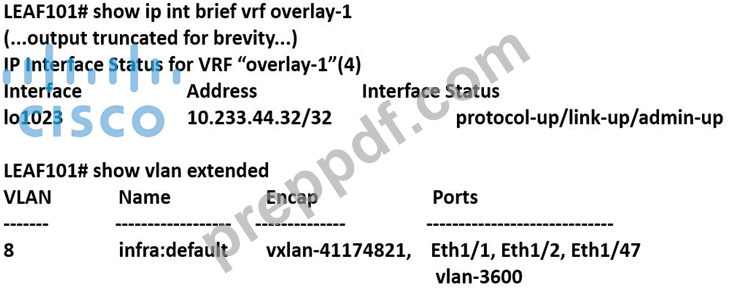
Which ACI fabric address is assigned to interface lo1023?
- A. Fabric tunnel endpoint
- B. Dynamic tunnel endpoint
- C. VXLAN tunnel endpoint
- D. Physical tunnel endpoint
Answer: A
Explanation:
In addition to loopback 0 interfaces, ACI creates loopback 1023 interfaces on all leaf switches.
A loopback 1023 interface is used for assignment of a single fabricwide pervasive IP address called a fabric tunnel endpoint (FTEP) address.
The FTEP address represents the entire fabric and is used to encapsulate traffic in VXLAN to an AVS or AVE virtual switch, if present.
NEW QUESTION # 186
An engineer is creating a configuration import policy that must terminate if the imported configuration is incompatible with the existing system. Which import mode achieves this result?
- A. atomic
- B. best effort
- C. merge
- D. replace
Answer: A
Explanation:
importMode
Best-effort mode: each MO is applied individually, and errors only cause the invalid MOs to be skipped.
Note
If the object is not present on the controller, none of the children of the object get configured.
Best-effort mode attempts to configure the children of the object.
Atomic mode: configuration is applied by whole shards. A single error causes whole shard to be rolled back to its original state.
https://www.cisco.com/c/en/us/td/docs/switches/datacenter/aci/apic/sw/4-x/aci- fundamentals/Cisco-ACI-Fundamentals-401/Cisco-ACI-Fundamentals- 401_chapter_01011.html
NEW QUESTION # 187
A network engineer is configuring syslogs in the Cisco ACI environment with these requirements:
- All message severities must be logged except for debugging messages.
- Messages must be compliant with RFC 5424 format.
- Logs must be saved only in a file on the APIC.
Which settings must be used in the Syslog Monitoring Destination Group to meet these requirements?
- A. Format: ACI
Local File Destination Admin State: Enabled
Severity: Information
Console Destination Admin State: Disabled - B. Format: NX-OS
Local File Destination Admin State: Disabled
Severity: Alerts
Console Destination Admin State: Enabled - C. Format: NX-OS
Local File Destination Admin State: Disabled
Severity: Emergencies
Console Destination Admin State: Enabled - D. Format: ACI
Local File Destination Admin State: Enabled
Severity: Notifications
Console Destination Admin State: Disabled
Answer: A
Explanation:
Format: ACI: The ACI format supports RFC 5424 compliance, making it suitable for this requirement.
Local File Destination Admin State: Enabled: To ensure that logs are saved only to a file on the APIC, the local file destination must be enabled.
Severity: Information: The "Information" level includes all message severities except for debugging messages, aligning with the requirement to log all except debugging.
Console Destination Admin State: Disabled: Since the requirement is to save logs only to a file on the APIC, the console logging must be disabled.
NEW QUESTION # 188
A network engineer must design a method to allow the Cisco ACI to redirect traffic to the firewalls.
Only traffic that matches specific L4-L7 policy rules should be redirected. The load must be distributed across multiple firewalls to scale the performance horizontally. Which action must be taken to meet these requirements?
- A. Configure ACI Service Graph with Symmetric PBR.
- B. Configure ACI Service Graph with Unidirectional PBR.
- C. Implement ACI Service Graph with GIPo.
- D. Implement ACI Service Graph Two Nodes with GIPo.
Answer: A
Explanation:

https://www.cisco.com/c/en/us/solutions/collateral/data-center-virtualization/application-centric- infrastructure/white-paper-c11-739971.html
NEW QUESTION # 189
Which routing protocol is supported between Cisco ACI spines and IPNs in a Cisco ACI Multi-Pod environment?
- A. OSPF
- B. EIGRP
- C. ISIS
- D. BGP
Answer: D
Explanation:
BGP is supported between Cisco ACI spines and IPNs in a Cisco ACI Multi-Pod environment.
NEW QUESTION # 190
Refer to the exhibit.
Refer to the exhibit. An engineer configures an L3Out but receives the error presented. Which action clears the fault?
- A. Acknowledge the QoS-related error.
- B. Create a custom QoS policy.
- C. Set the QoS policy to Level 3.
- D. Associate a custom QoS class.
Answer: A
NEW QUESTION # 191
An engineer has set the VMM resolution immediacy to pre-provision in a Cisco ACI environment. No Cisco Discovery Protocol neighborship has been formed between the hypervisors and the ACI fabric leaf nodes.
How does this affect the download policies to the leaf switches?
- A. No policies are downloaded because there is no discovery protocol neighborship.
- B. No policies are downloaded because LLDP is the only supported discovery protocol.
- C. Policies are downloaded when the hypervisor host is connected to the VMM VDS.
- D. Policies are downloaded to the ACI leaf switch regardless of Cisco Discovery Protocol neighborship.
Answer: D
NEW QUESTION # 192
Cisco ACI fabric contains 10 standalone leaf switches. An engineer must configure only the first two leaf switches in a VPC. Which VPC protection type must be configured to accomplish goal?
- A. serial
- B. reciprocal
- C. explicit
- D. consecutive
Answer: C
Explanation:
The scenario involves a Cisco ACI fabric with 10 standalone leaf switches, and the engineer must configure only the first two leaf switches (e.g., Leaf-1 and Leaf-2) in a Virtual Port Channel (vPC) configuration. The goal is to select the appropriate vPC protection type to achieve this specific pairing while leaving the other eight leaf switches standalone.
Requirement Analysis
In Cisco ACI, vPC is used to provide active-active link redundancy and load balancing between two leaf switches connected to the same set of endpoints (e.g., servers or external devices).
The fabric contains 10 standalone leaf switches, meaning no pre-existing vPC pairs are configured, and the task is to form a vPC specifically between the first two leaf switches.
The vPC protection type determines how the pair is defined and protected within the ACI fabric, ensuring the configuration is limited to the intended switches.
Option Evaluation
A . serial:
The "serial" protection type is not a valid vPC protection option in Cisco ACI. This term might be confused with serial link configurations or other networking contexts, but it does not apply to vPC in ACI.
Reference:
B . explicit:
The "explicit" vPC protection type allows the engineer to manually specify the exact pair of leaf switches to form a vPC. In this case, the engineer can configure Leaf-1 and Leaf-2 as an explicit vPC pair, leaving the other eight leaf switches standalone. This method provides precise control over which switches are paired, aligning with the requirement to configure only the first two.
C . reciprocal:
The "reciprocal" protection type is not a standard vPC protection option in ACI. This term might imply mutual protection, but it is not documented as a specific vPC configuration mode in ACI.
D . consecutive:
The "consecutive" protection type is not a recognized vPC protection option in ACI. It might suggest pairing switches based on their IDs (e.g., consecutive node IDs), but ACI does not use this as a formal protection mechanism. The fabric could interpret this incorrectly, potentially pairing unintended switches.
Final Answer Justification
B is correct because the "explicit" vPC protection type allows the engineer to manually designate Leaf-1 and Leaf-2 as a vPC pair, ensuring that only these two switches are configured in a vPC while the remaining eight leaf switches remain standalone. This method provides the precision needed to meet the goal and is a standard feature in ACI vPC deployments.
Primary Cisco Reference:
Cisco APIC Layer 2 Networking Configuration Guide, "Configuring vPC with Explicit Protection." Cisco ACI Design Guide, "vPC Deployment Options." Cisco ACI vPC Best Practices, "Explicit vPC Pair Configuration."
NEW QUESTION # 193
A network engineer must configure a new SNMP configuration and syslog servers. The requirement is for all faults and events related to endpoint groups, bridge domains, and VRFs to be sent to it. Which action must be taken to meet the requirements?
- A. Utilize common tenant monitoring policies in the Cisco APIC.
- B. Configure fabric monitoring policies and attach to the spine switch in the fabric.
- C. Enable access monitoring policies on the required endpoint groups, bridge domains, and VRFs.
- D. Implement fabric-wide monitoring policies on all nodes.
Answer: D
NEW QUESTION # 194
Refer to the exhibit.
Refer to the exhibit. A tenant is configured with a single L30ut and a single-homed link to the core router called Core-1. An engineer must add a second link to the L30ut that connects to Core-2 router. Which action allows the traffic from Core-2 to BL-1002 to have the same connectivity as the traffic from Core-1 to BL-1001?
- A. Add a second path to the logical interface profile of the existing L30ut
- B. Add a second subnet to the external EPG to the existing L30ut.
- C. Add a second OSPF interface profile to the logical interface profile.
- D. Add a second interface to the external domain to the existing L30ut.
Answer: A
Explanation:
The scenario involves a tenant configured with a single L3Out and a single-homed link from the ACI fabric (via border leaf BL-1001) to a core router (Core-1). The engineer must add a second link to the L3Out, connecting to Core-2 via BL-1002, ensuring that traffic from Core-2 to BL-1002 has the same connectivity as traffic from Core-1 to BL-1001. The exhibit shows a single-homed setup with BL-1001 and BL-1002 as potential border leaves, with a dashed line indicating a planned second link.
Requirement Analysis
The existing L3Out is single-homed to Core-1 via BL-1001, and the goal is to extend it to a multi-homed configuration with Core-2 via BL-1002.
"Same connectivity" implies that the second link must be integrated into the existing L3Out configuration, sharing the same routing policies, external EPG, and subnet reachability.
The solution must leverage ACI's L3Out framework to add the new path without creating a separate L3Out or altering the current routing setup unnecessarily.
Option Evaluation
A . Add a second path to the logical interface profile of the existing L3Out:
The logical interface profile in an L3Out defines the interfaces (e.g., routed ports or sub-interfaces) and their associations with nodes (border leaves). Adding a second path to this profile allows the inclusion of the new link from BL-1002 to Core-2, ensuring it operates under the same L3Out configuration (e.g., routing protocol, external EPG). This maintains consistent connectivity and leverages ACI's multi-homing support.
Reference:
B . Add a second subnet to the external EPG to the existing L3Out:
Adding a subnet to the external EPG defines additional networks advertised or learned via the L3Out, but it does not address the addition of a new physical link or path. This is irrelevant to the connectivity requirement for the second link.
C . Add a second OSPF interface profile to the logical interface profile:
While the L3Out uses OSPF (implied by the context), adding a second OSPF interface profile would create a separate routing instance, which is unnecessary and could disrupt consistency. The existing OSPF configuration can be extended via the logical interface profile.
D . Add a second interface to the external domain to the existing L3Out:
The external domain associates VLAN pools, but it does not define paths or interfaces for L3Out connectivity. This option is incorrect as it confuses domain configuration with interface path management.
Final Answer Justification
A is correct because adding a second path to the logical interface profile of the existing L3Out integrates the new link from BL-1002 to Core-2 into the same routing and policy framework, ensuring equivalent connectivity to the Core-1 to BL-1001 link. This aligns with ACI's support for multi-homed L3Outs.
Primary Cisco Reference:
Cisco APIC Layer 3 Networking Configuration Guide, "L3Out Multi-Homing." Cisco ACI Best Practices, "Expanding L3Out Connectivity."
NEW QUESTION # 195
An engineer must securely export Cisco APIC configuration snapshots to a secure, offsite location The exported configuration must be transferred using an encrypted tunnel and encoded with a platform-agnostic data format that provides namespace support Which configuration set must be used?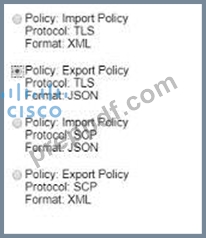
- A. Option C
- B. Option A
- C. Option D
- D. Option B
Answer: C
NEW QUESTION # 196
An EPG is associated with a VMM domain. Which option must be set to allow the bridge domain and the VRF of the EPG to be instantiated on all leaf switches that discovered the ESXi host?
- A. On-Demand Resolution immediacy
- B. Immediate Deployment immediacy
- C. Immediate Resolution immediacy
- D. On-Demand Deployment immediacy
Answer: D
Explanation:
Setting the EPG's Deployment immediacy to On-Demand ensures that the bridge domain and VRF are only pushed down to - and instantiated on - the leaf switches that actually see the ESXi host, rather than all leaves up front.
NEW QUESTION # 197
Refer to the exhibit. An engineer is implementing a BPDU filter on external switch interfaces that face the Cisco ACI fabric to prevent excessive TCNs from impacting the fabric. Which configuration must be applied on Cisco ACI to avoid a Layer 2 loop?
- A. Implement BPDU Guard.
- B. Enable STP on downlinks.
- C. Configure MCP globally.
- D. Apply an MSTP instance on Cisco ACI.
Answer: C
Explanation:
https://www.linkedin.com/pulse/cisco-aci-network-behaviour-stptcn-how-identify-loop-ankit- kulshresta
NEW QUESTION # 198
Which feature should be disabled on a bridge domain when a default gateway for endpoints is on an external device instead of a Cisco ACI bridge domain SVI?
- A. proxy ARP
- B. unknown unicast flooding
- C. ARP flooding
- D. unicast routing
Answer: D
Explanation:
When the default gateway for endpoints is on an external device instead of a Cisco ACI bridge domain Switched Virtual Interface (SVI), the unicast routing feature should be disabled on the bridge domain. This prevents the ACI fabric from attempting to route traffic for the endpoints, which should instead be directed to the external default gateway.
NEW QUESTION # 199
An engineer must configure VMM domain integration on a Cisco UCS B-Series server that is connected to a Cisco ACI fabric. Drag and drop the products used to create VMM domain from the bottom into the sequence in which they should be implemented at the top. Products are used more than once.
Answer:
Explanation:
NEW QUESTION # 200
A data center administrator is upgrading an ACI fabric. There are 3 APIC controllers in the fabric and all the servers are dual-homed to pairs of leaf switches configured in VPC mode. How should the fabric be upgraded to minimize possible traffic impact during the upgrade?
- A. Option C
- B. Option A
- C. Option D
- D. Option B
Answer: B
NEW QUESTION # 201
......
To pass the exam, candidates must demonstrate a deep understanding of ACI architecture and be able to configure, manage, and troubleshoot ACI deployments. They must also understand how to automate ACI tasks using REST APIs and Python scripts. Implementing Cisco Application Centric Infrastructure certification exam consists of 60-70 multiple-choice questions and lasts 90 minutes. Candidates who pass the exam will receive the Cisco Certified Specialist - ACI Implementation certification, which demonstrates their expertise in ACI implementation and management.
PrepPDF 300-620 Exam Practice Test Questions: https://measureup.preppdf.com/Cisco/300-620-prepaway-exam-dumps.html